 Art
Art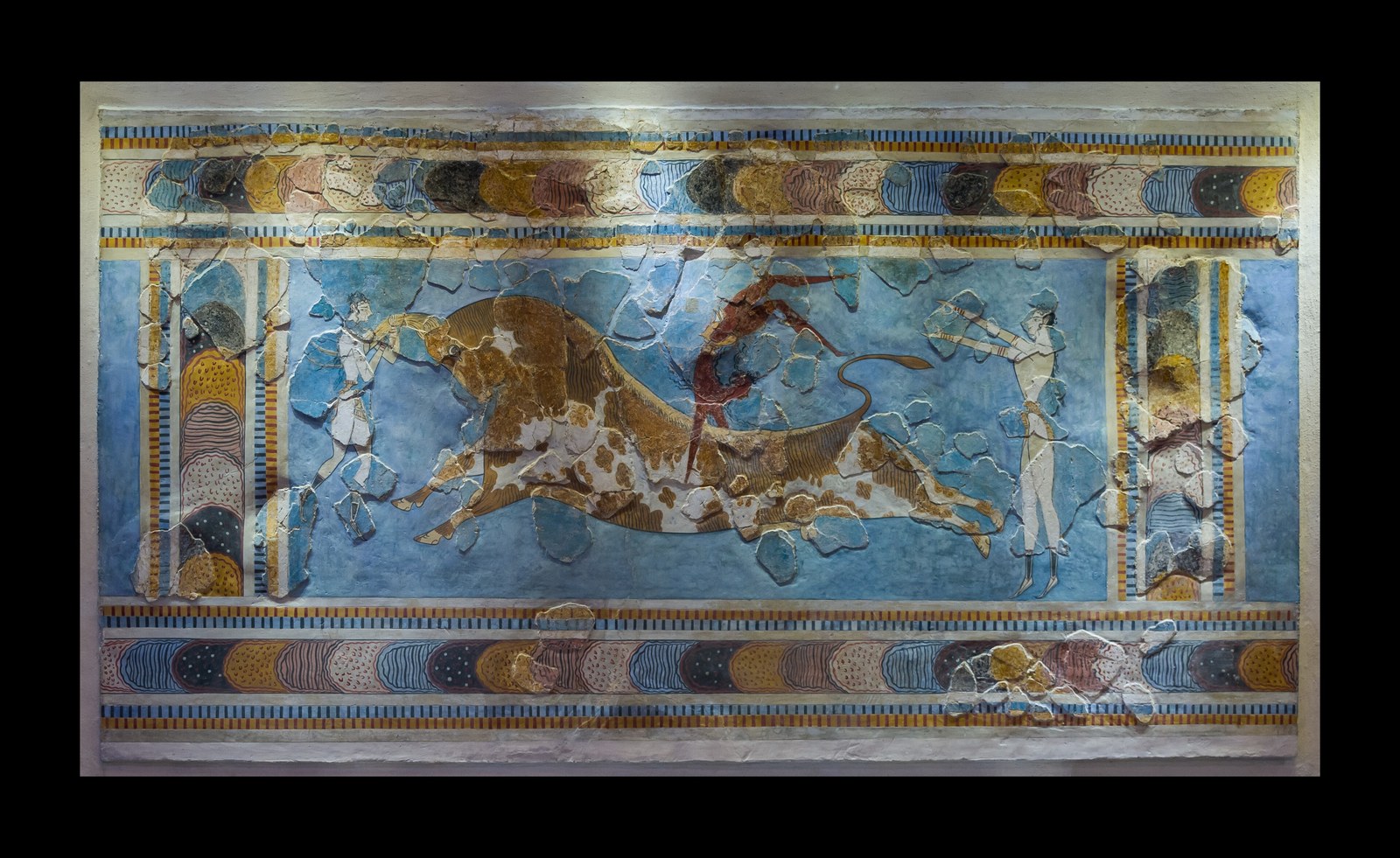
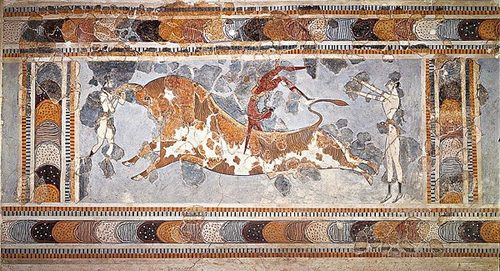
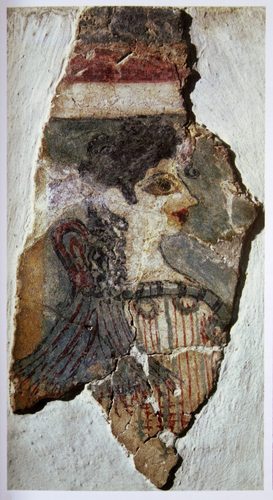
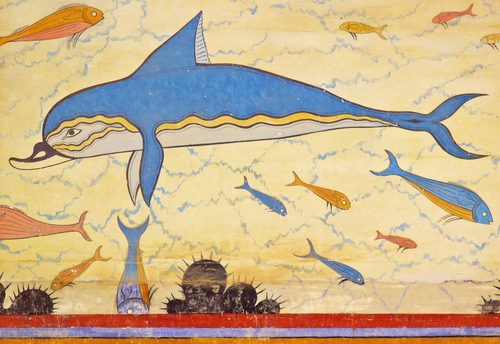
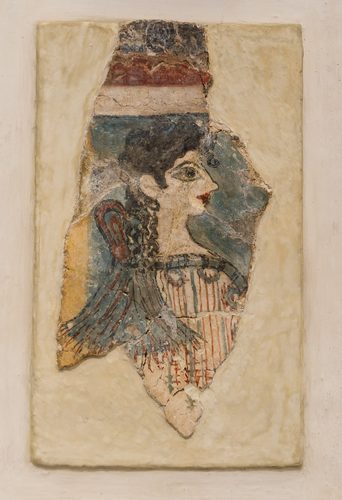
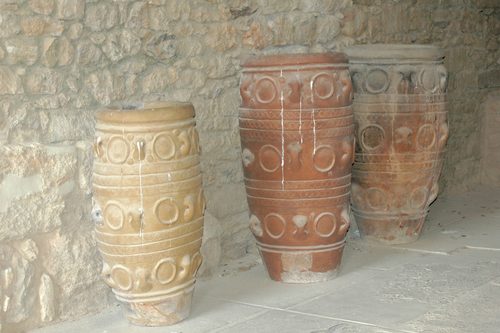
Crete's art history spans two separated peaks nearly three thousand years apart. Between roughly 2000 and 1450 BCE, the Minoan civilization built unfortified palaces at Knossos, Phaistos, and Malia, decorating their walls with fresco scenes of bull-leaping, processions, and marine life rendered in flat color with no fixed viewpoint, a style unlike anything on the Greek mainland at the time. Kamares ware pottery from the same period paired dark backgrounds with light, swirling floral and spiral decoration. This Bronze Age tradition ended with the eruption of Thera and a Mycenaean takeover around 1450 BCE. A second, unrelated flowering followed the fall of Constantinople in 1453, when Byzantine icon painters resettled on Venetian-ruled Crete. Working chiefly from Candia, today's Heraklion, they developed the Cretan School, merging traditional Byzantine gold-ground composition with modeling and perspective learned from Italian Renaissance painting arriving through Venice. This hybrid technique, produced by workshop painters for churches across the Orthodox world, remained Crete's defining art form until the Ottoman conquest of 1669 scattered its painters to Venice and the Ionian islands.
What marks the region
True fresco technique
Wall paintings applied to wet lime plaster, using flat color blocks and dark outlines rather than shading or fixed perspective, a Minoan hallmark.
Marine and nature motifs
Octopi, dolphins, lilies, and papyrus recur across both fresco and pottery, reflecting a Bronze Age culture oriented toward the sea rather than mainland warfare.
Unfortified palace sites
Minoan palace complexes had no defensive walls, a contrast to fortified Mycenaean citadels and a sign of the era's naval rather than military security.
Byzantine-Venetian hybrid panels
Cretan School icons kept Byzantine gold backgrounds and frontal composition but added Italian-style shading and anatomical modeling to faces and drapery.
Egg tempera on gesso
Icon painters built up thin egg tempera layers over a chalk gesso ground, finishing with gold leaf backgrounds applied before the figures were painted.
Export workshop production
Cretan icon workshops produced panels for churches and patrons across the Orthodox Mediterranean, not only for local Cretan use.
Local signatures
How to spot Crete art
- Double axe (labrys)
- → A Minoan religious and palace symbol, carved into stone and appearing in ritual contexts at Knossos.
- Horns of consecration
- → Stylized bull horns placed atop Minoan buildings and altars, marking sacred space.
- Octopus motif
- → A recurring Minoan pottery and fresco device, tentacles spread to fill curved vessel surfaces.
- Snake-holding figure
- → A Minoan votive figure type associated with household or palace ritual, arms raised holding snakes.
- Gold-ground icon background
- → Flat gold leaf behind painted figures, the Cretan School's inherited Byzantine convention signaling sacred, timeless space.
- Elongated icon figures
- → Cretan School saints rendered with attenuated proportions, a stylistic bridge between Byzantine abstraction and Renaissance naturalism.
The story
Minoan civilization reached its height between about 2000 and 1450 BCE, building the palace at Knossos that Arthur Evans excavated and partially reconstructed between 1900 and 1935, reconstructions now understood to combine genuine fragments with speculative repainting. Frescoes such as the Bull-Leaping panel and Kamares ware pottery date from this period, before the eruption of Thera around 1600 BCE and a Mycenaean takeover of Crete around 1450 BCE brought the palace culture to an end. Crete's second major art period began after the fall of Constantinople in 1453, when Byzantine painters resettled on the island under Venetian rule, established since 1211. Candia, present-day Heraklion, became a center for icon workshops blending Byzantine and Italian Renaissance technique; painters including Michael Damaskinos worked there through the 16th century, and Domenikos Theotokopoulos trained in this Cretan tradition before leaving for Venice and later Spain, where he became known as El Greco. The Ottoman conquest of Candia in 1669 ended Venetian rule and dispersed the Cretan School's remaining painters to Venice and the Ionian Islands.
Masterpieces of the place
| Work | Artist | Date | Why it matters |
|---|---|---|---|
| Bull-Leaping Fresco | Unknown | c. 1400 BCE | The best-known Minoan image, showing a figure vaulting over a charging bull at Knossos. |
| Kamares Ware Jar | Unknown | c. 1800 BCE | A polychrome vessel from Phaistos with swirling floral pattern on a dark ground. |
| Prince of the Lilies Relief Fresco | Unknown | c. 1550 BCE | A painted plaster relief figure from Knossos, partly reconstructed during early 20th-century excavation. |
| Virgin Glykophilousa Icon | Michael Damaskinos | c. 1570 | A Candia workshop icon blending Byzantine gold ground with Italian-influenced facial modeling. |
| Cretan-period Icon Work | Domenikos Theotokopoulos | c. 1560s | An early painting from before the artist's move to Venice, made within the Candia icon workshop tradition. |
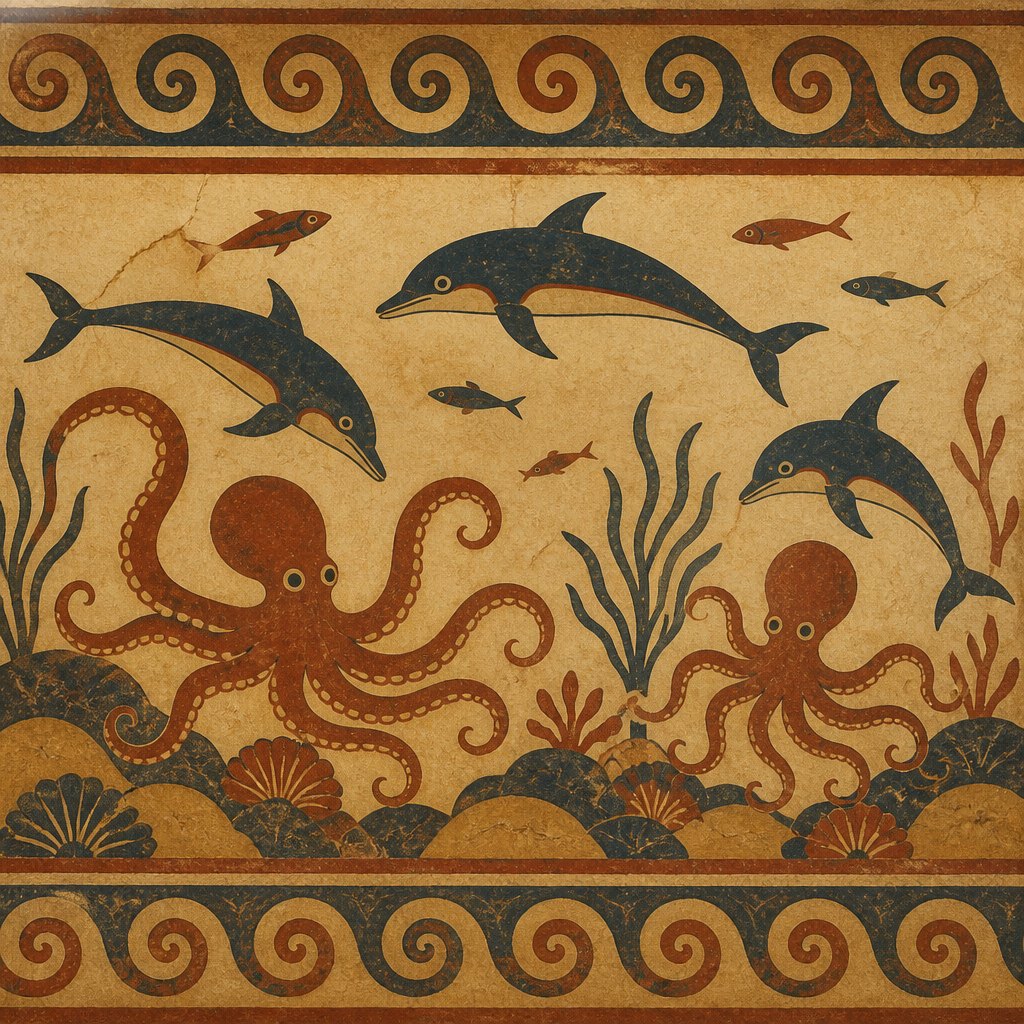 AI-generated
Work en plein air
Paint in the light of Crete
This example was generated from a prompt like: “A Bronze Age palace wall painted in flat ochre, red, and blue-black, showing a marine scene of octopi and dolphins in profile, bordered by a spiral pattern, in the flat, perspective-free Minoan fresco style.”
Open the Crete Art Style generator →The place today
The Heraklion Archaeological Museum holds the major collection of Minoan frescoes, pottery, and seals, alongside the partially reconstructed palace site at Knossos itself. The Historical Museum of Crete in Heraklion preserves Cretan School icons and related Byzantine-Venetian material. Orthodox monasteries across Crete still hold icon collections in active liturgical use, and traditional egg-tempera icon painting continues as a practiced craft supplying churches with new work in the historic style.
Compose your own
For a Minoan look, work in flat blocks of ochre, red, and blue-black outlined in dark contour, with figures shown in a mix of profile body and frontal eye rather than consistent perspective. Fill space with marine or floral motifs, octopi, dolphins, lilies, curling to match a curved wall or vessel surface. For a Cretan School icon look, start with a gold leaf background applied flat behind the composition, then build the figure in thin egg tempera layers over white gesso, keeping poses frontal and symmetrical but adding subtle three-quarter shading to the face and hands, an Italian Renaissance touch layered onto Byzantine composition. Keep both traditions restrained in palette and avoid deep atmospheric perspective; space is implied through overlap and scale, not vanishing points.
Frequently asked questions
Are the Knossos frescoes original or reconstructed?
Both. Archaeologist Arthur Evans's excavations from 1900 to 1935 combined genuine painted fragments with substantial repainting and reconstruction, a practice modern archaeology treats as informed but partly speculative.
What is the Cretan School of icon painting?
A 15th-17th century tradition centered on Venetian-ruled Candia, blending Byzantine gold-ground composition with Italian Renaissance modeling, ending after the Ottoman conquest of the island in 1669.
Did El Greco train in Crete?
Yes. Domenikos Theotokopoulos trained as an icon painter in the Cretan School before moving to Venice and later Spain, where he became known by his Italian nickname, El Greco.
What ended Minoan civilization on Crete?
A combination of the Thera volcanic eruption around 1600 BCE and a Mycenaean takeover of Crete around 1450 BCE brought the palace-based Minoan culture to an end.