 Art
Art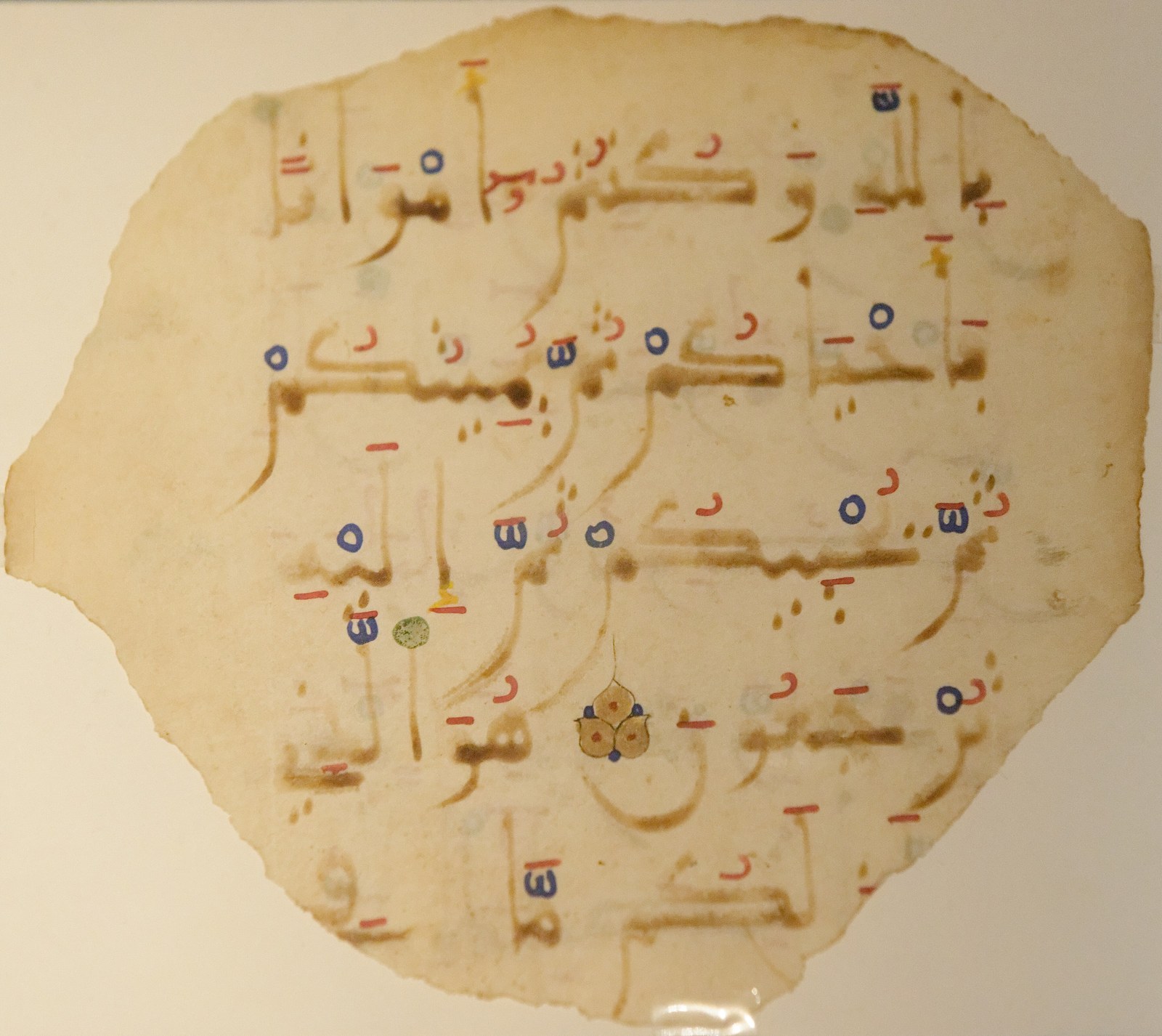
![Askiyah's Questions and al-Maghili's Answers [al-Maghili's Tract on Politics] — Timbuktu](https://media.artregions.com/encyclopedia/timbuktu-art/commons-4-thumb.jpg)
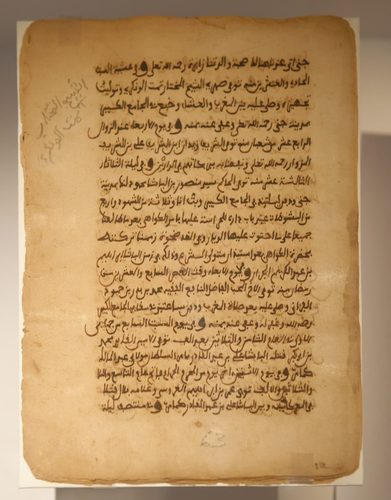
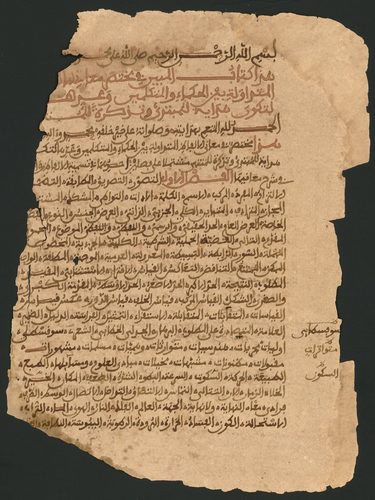
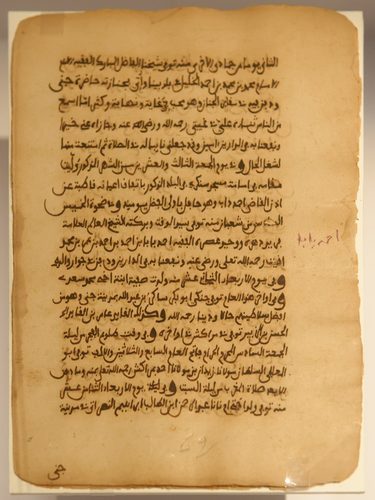
Timbuktu sits near the Niger River's northern bend in present-day Mali, at the point where trans-Saharan caravan routes met river trade. Gold, salt, and enslaved people moved through the city from the 1300s onward, and the resulting wealth supported not a painting school but a scholarly one: Quranic law, astronomy, and medicine copied and annotated on imported paper in Maghribi and Sudani Arabic scripts. Mansa Musa's 1324 pilgrimage to Mecca brought back the architect al-Sahili, whose mudbrick mosques, Djinguereber and later Sankore, became the city's visual signature: thick earthen walls braced with projecting palm-wood beams that double as scaffolding for annual replastering. Manuscripts were kept in private family libraries rather than one royal collection, illuminated with geometric borders and colored inks rather than figural imagery, since Islamic practice discouraged figuration. Timbuktu's art, in effect, is architecture and the written page, both built to survive Saharan heat through mass, shade, and continual maintenance.
What marks the region
Mudbrick construction
Buildings are raised in sun-dried earthen brick (banco) over stone footings, thick enough to insulate against desert heat and requiring seasonal replastering to survive rains.
Toron scaffolding
Palm-wood beams project permanently from mosque facades, doubling as built-in scaffolding for the yearly crepissage, when townspeople replaster the walls by hand.
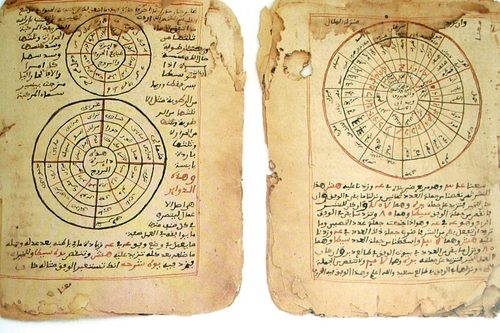
Manuscript illumination without figures
Pages carry geometric borders, colored ink diagrams, and calligraphic emphasis in red or gold rather than portraits or narrative scenes, following regional Islamic convention.
Family library preservation
Manuscripts were kept and copied within individual scholarly families for generations, not centralized, which scattered the collection but also protected it from single-site loss.
Maghribi and Sudani script
Local scribes used rounded North African Maghribi letterforms and a distinct Sudani hand, adapted for writing Songhay, Tamasheq, and Fulfulde as well as Arabic.
Imported paper, local binding
Paper reached Timbuktu via Mediterranean and Moroccan trade routes; local craftsmen bound finished manuscripts in tooled leather covers suited to Sahelian climate.
Local signatures
How to spot Timbuktu art
- Projecting toron beams
- → Permanent scaffolding built into mudbrick mosque facades, a structural and visual signature of Sahelian architecture.
- Geometric manuscript border
- → Framing device replacing figural illustration, marking a page as a formal or scholarly text.
- Red ink emphasis
- → Used within otherwise black Arabic text to highlight key terms, corrections, or chapter divisions in legal and religious manuscripts.
- Pyramidal mihrab tower
- → The stepped, conical form of Sankore and Djinguereber mosque towers, distinct from domed Middle Eastern mosque architecture.
- Colophon with scribe's name
- → A closing note identifying the copyist and date, turning anonymous texts into traceable objects of scholarly lineage.
- Tooled leather binding
- → Locally made covers protecting imported paper, adapted from wider Islamic bookbinding traditions to Sahelian materials.
The story
Timbuktu grew from a seasonal Tuareg camp into a trading city by the 1100s, positioned where Saharan caravan routes met Niger River traffic. Mansa Musa of the Mali Empire, returning from his 1324 pilgrimage to Mecca, commissioned the architect Abu Ishaq al-Sahili to build the Djinguereber Mosque, completed around 1327. Under later Songhai rule, the 15th and 16th centuries brought the city's scholarly peak, with scholars around the Sankore Mosque producing and copying manuscripts on law, astronomy, and theology. A Moroccan army conquered the city in 1591, and its influence declined as Atlantic trade routes bypassed the Sahara. France annexed Timbuktu in 1893. UNESCO listed its three great mosques and sixteen mausoleums as a World Heritage Site in 1988. In 2012, Islamist groups occupied the city and destroyed several listed mausoleums; librarians led by Abdel Kader Haidara smuggled tens of thousands of manuscripts to Bamako for safekeeping, and restoration work has continued since.
Masterpieces of the place
| Work | Artist | Date | Why it matters |
|---|---|---|---|
| Djinguereber Mosque | Abu Ishaq al-Sahili | 1327 | Commissioned by Mansa Musa, its mudbrick mass and toron beams became the city's architectural template. |
| Sankore Mosque | Unknown | 14th century, rebuilt later | Center of the manuscript-copying scholarly community associated with Timbuktu's intellectual peak. |
| Tarikh al-Sudan | Abd al-Rahman al-Sadi | 1655 | A chronicle of the Songhai Empire, one of the most cited historical manuscripts from the Timbuktu tradition. |
| Sidi Yahya Mosque | Unknown | 15th century | Third of Timbuktu's three great mosques, associated with a revered local scholar-saint. |
| Tarikh al-Fattash | Attributed to Mahmud Kati | 16th–17th century compilation | A companion chronicle to the Tarikh al-Sudan, illustrating the region's manuscript historiography. |
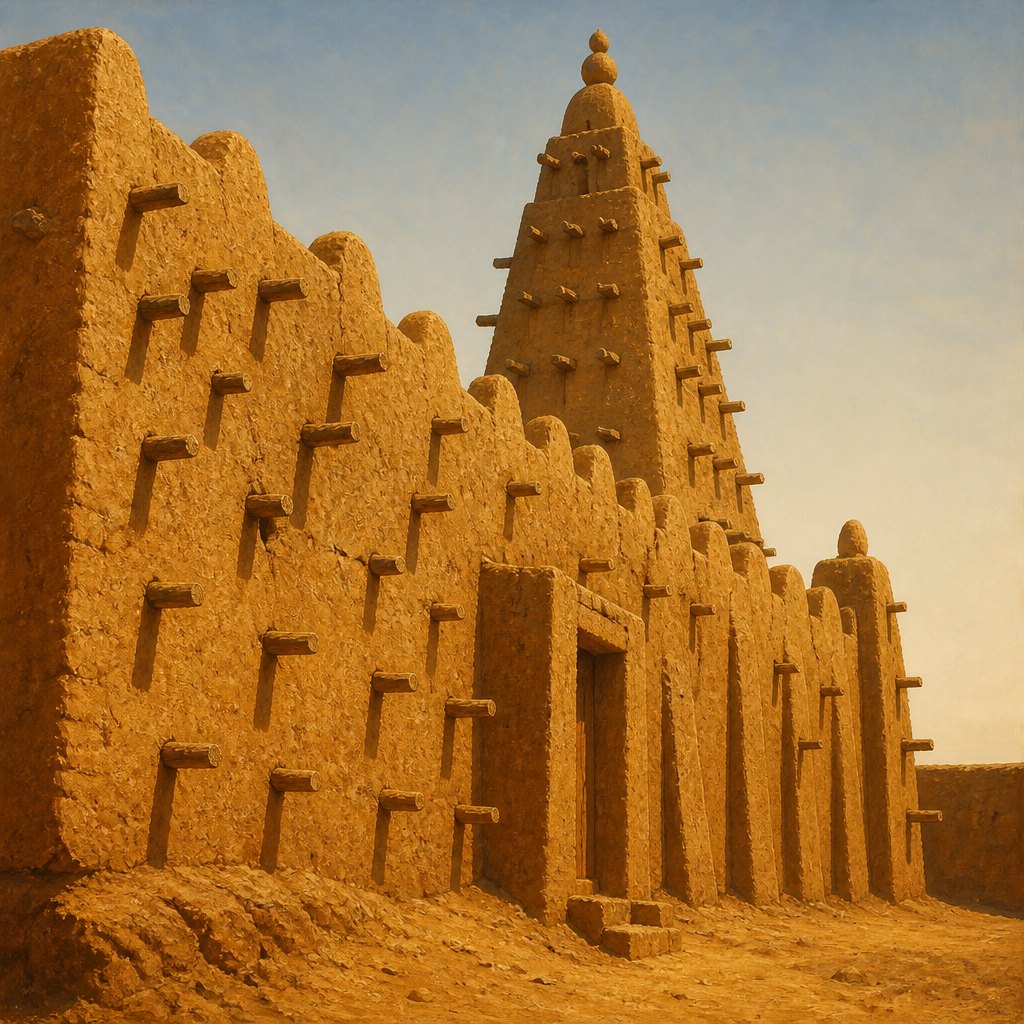 AI-generated
Work en plein air
Paint in the light of Timbuktu
This example was generated from a prompt like: “A sun-baked mudbrick mosque wall at midday, thick earthen surface studded with regularly spaced projecting wooden beam-ends, a stepped tapering tower rising against a pale desert sky, rendered in warm ochre and umber tones.”
Open the Timbuktu Art Style generator →The place today
Timbuktu's three great mosques, Djinguereber, Sankore, and Sidi Yahya, remain active and are maintained through the annual crepissage replastering tradition. The Ahmed Baba Institute and private family libraries such as the Mamma Haidara Memorial Library hold surviving manuscripts, many digitized after the 2012 evacuation to Bamako. UNESCO lists the site as endangered World Heritage, and conservation and cataloguing work continues alongside efforts to return manuscripts safely to the city.
Compose your own
Evoke Timbuktu through mass and texture rather than figure or color contrast. Render walls as thick, sun-baked earthen planes in warm ochre and umber, broken by regularly spaced wooden beam-ends jutting from the surface. Keep any script-like elements geometric and non-figural: dense black lines with occasional red accents inside a plain rectangular border, echoing manuscript pages rather than illustrated scenes. Light should read as flat and high, midday Saharan sun with short, hard shadows rather than atmospheric haze. Avoid domes; favor the stepped, tapering mosque tower silhouette. Keep the palette narrow, sand, clay, ink black, and a touch of gold leaf, to match the restrained material world of mudbrick architecture and hand-copied scholarship.
Frequently asked questions
Was Timbuktu known for painting or sculpture?
No. Its reputation rests on Islamic manuscript scholarship and mudbrick mosque architecture. Figural painting and sculpture were not part of this tradition, which favored calligraphy, geometric decoration, and earthen construction instead.
What are the Timbuktu manuscripts about?
They cover Islamic law, Quranic commentary, astronomy, medicine, and regional history, written mainly in Arabic script by scholars working within family libraries across several centuries, from roughly the 1400s to the 1800s.
Why do Timbuktu's mosques have wooden beams sticking out of the walls?
Those torons are permanent scaffolding built into the mudbrick facade. Each year during the crepissage, workers climb them to replaster the walls by hand, which is necessary because mudbrick erodes in seasonal rains.
What happened to the manuscripts during the 2012 conflict?
When Islamist groups occupied Timbuktu in 2012, librarians secretly moved tens of thousands of manuscripts out of the city to Bamako for safekeeping, an evacuation now documented as one of the notable manuscript rescues of the period.