 Art
Art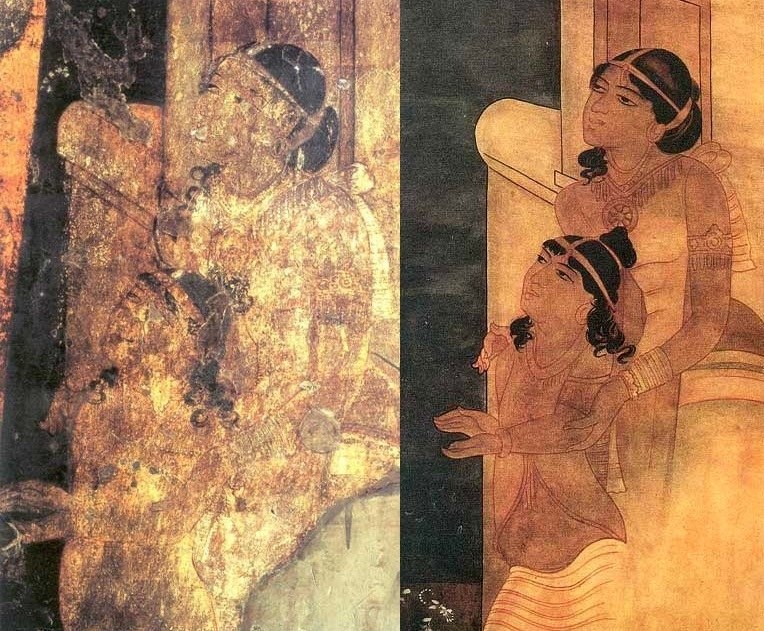
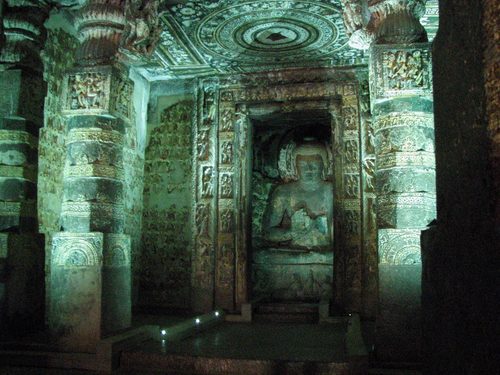
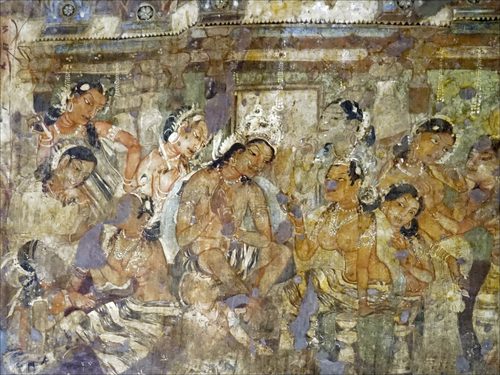
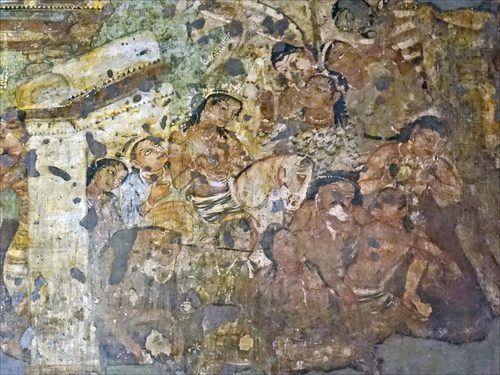
Ajanta is a complex of 30 Buddhist rock-cut caves carved into a horseshoe-shaped cliff above the Waghora river in present-day Maharashtra, India. Excavation happened in two widely separated phases: an early Hinayana group cut under Satavahana patronage around the 2nd-1st centuries BCE, and a much richer Mahayana phase compressed into roughly two decades under the Vakataka king Harisena, who reigned circa 460-477 CE. Merchants and courtiers funded chaitya prayer halls and vihara monasteries, and monks decorated their walls with murals illustrating Jataka tales of the Buddha's past lives alongside scenes of palace life and celestial beings. Painters worked in tempera on dry lime plaster rather than true fresco, building up mineral pigments over a mud-and-dung ground coat. When Vakataka patronage ended around 480 CE, work stopped abruptly and the site was gradually abandoned, leaving its paintings sealed from light and traffic until the 19th century.
What marks the region
Tempera on dry plaster
Painters coated cave walls with a rough mud-and-dung plaster, added a fine lime finish, and painted in tempera once it had set, not the wet-plaster buon fresco technique used later in Europe.
Rock-cut architecture
Every cave was carved downward and inward from a single basalt cliff face, chaitya halls with vaulted ceilings and vihara monasteries with cells, sculpted rather than assembled from separate stone blocks.
Continuous narrative
Jataka tales unfold across a single wall in overlapping episodes rather than separate framed scenes, crowding one surface with multiple moments from the same story read in sequence.
Graded shading (vartana)
Figures gain volume through tonal shading around the eyes, nose, and torso, an early Indian approach to modeling achieved with dark outline and graded wash rather than line alone.
Tribhanga pose
Bodhisattvas and courtly figures stand in a triple-bent pose, weight shifted onto one hip, a posture that became standard for elegant figures across South and Southeast Asian religious art.
Court life beside doctrine
Religious narrative shares wall space with unrelated detail, hairstyles, jewelry, textiles, and processions of the Vakataka court, giving the murals value as social record as well as scripture.
Local signatures
How to spot Ajanta art
- Lotus flower
- → Held by a bodhisattva, identifying him as Padmapani, the 'lotus-bearer' of Cave 1's most reproduced mural.
- Jeweled crown
- → Marks a bodhisattva or royal figure as distinct from a plainer, unadorned Buddha or monk in the same composition.
- Tribhanga stance
- → The triple-bend pose signals grace and divinity, distinguishing celestial and noble figures from stiffer attendant figures.
- Elongated half-closed eyes
- → A meditative, inward gaze rendered with a long curved eye line, shared across Ajanta's bodhisattva figures.
- Flying celestial pairs
- → Airborne figures scattering flowers mark a scene as paradise or a moment of cosmic significance above the main narrative.
- Carved elephant and lotus motifs
- → Recurring pillar and doorway motifs signal auspiciousness and mark the transition from secular to sacred space.
The story
Ajanta's earliest caves belong to the Hinayana phase, cut under Satavahana-era patronage from roughly the 2nd century BCE, simple chaitya halls with little figural decoration. Excavation then stopped for centuries. A second, far more elaborate phase began under the Vakataka dynasty, concentrated in the reign of Harisena, circa 460-477 CE, when courtiers and officials sponsored new caves in a burst of activity that produced most of the surviving murals and sculpture. Work ended abruptly after Harisena's death around 480 CE as Vakataka power fragmented, leaving several caves unfinished. The site was gradually abandoned, overtaken by jungle, and left undisturbed for over a thousand years. In 1819 a British East India Company officer, John Smith, came across the caves while on a tiger-hunting expedition, and the site entered European scholarship. Restoration followed through the 19th and 20th centuries, and Ajanta was inscribed as a UNESCO World Heritage Site in 1983.
Masterpieces of the place
| Work | Artist | Date | Why it matters |
|---|---|---|---|
| Padmapani Bodhisattva mural, Cave 1 | Unknown | c. 5th century CE | The site's most celebrated painting, a lotus-holding bodhisattva with lowered eyes and jeweled crown. |
| Dying Princess mural, Cave 16 | Unknown | c. 5th century CE | A court scene noted for its unusually direct rendering of grief among figural narrative murals. |
| Chaitya hall, Cave 26 | Unknown | c. 5th-6th century CE | A rock-cut prayer hall with a large relief of the reclining Buddha carved along one wall. |
| Chaitya hall facade, Cave 19 | Unknown | c. 5th century CE | An ornately carved horseshoe-window facade marking the height of Vakataka-phase rock-cut architecture. |
| Chaitya hall, Cave 10 | Unknown | c. 2nd century BCE | One of the earliest caves at the site, an apsidal hall with plain octagonal pillars from the Hinayana phase. |
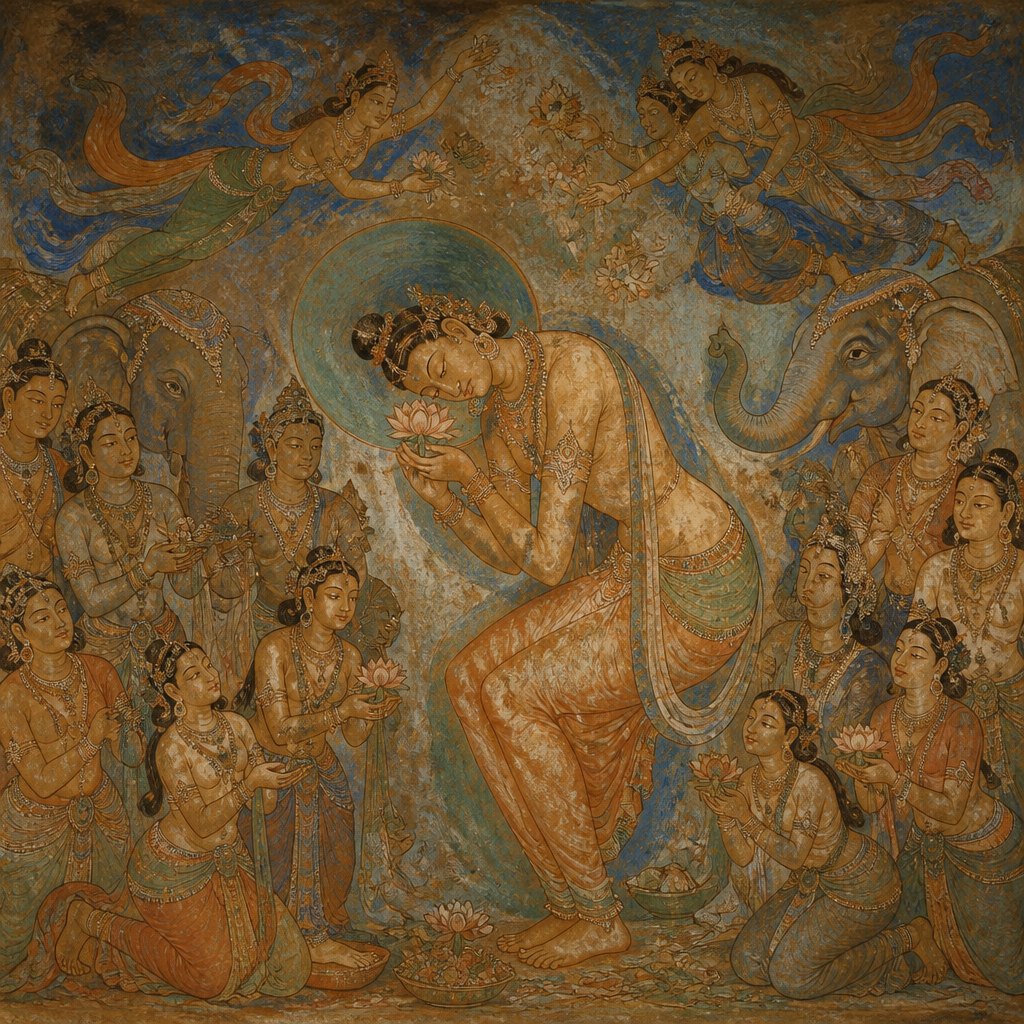 AI-generated
Work en plein air
Paint in the light of Ajanta
This example was generated from a prompt like: “A crowded cave-temple wall painted in ochre, terre verte, and mineral blue: a robed figure in a triple-bent pose holding a lotus, surrounded by attendants, elephants, and flying celestial figures scattering flowers overhead.”
Open the Ajanta Art Style generator →The place today
The Archaeological Survey of India manages Ajanta as a protected monument, with a visitor center and controlled lighting installed to slow further fading of the murals. UNESCO listing in 1983 brought sustained conservation funding, though tourist volume and humidity remain ongoing concerns. Nearby Ellora, with later Hindu, Buddhist, and Jain caves, is often visited alongside Ajanta as a single circuit. Photographic and painted copies made in the 19th and 20th centuries, some now lost, remain important records of murals that have since deteriorated further.
Compose your own
Work with a limited earth palette: red and yellow ochre, mineral blue, terre verte green, black outline, applied as flat tempera washes over a plain buff ground rather than blended oil glazes. Build faces around a long curved eye line and a calm, downward gaze, and give any bodhisattva or noble figure a triple-bent standing pose with weight settled on one hip. Crowd the wall: let architecture, attendants, animals, and celestial figures share a single continuous field rather than isolating the main figure in empty space. Use graded dark-to-light shading around the nose, collarbone, and torso to suggest volume, and finish jewelry and crowns with more detail than surrounding drapery.
Frequently asked questions
What is unusual about Ajanta's painting technique?
The murals are tempera on dry lime plaster rather than true wet-plaster fresco. Painters built up a mud-and-dung base coat, added a thin lime finish, then applied mineral pigments once the surface had set.
Why are there two distinct phases at Ajanta?
An early Hinayana phase under Satavahana patronage from the 2nd century BCE produced plain caves with little decoration. A second burst under the Vakataka king Harisena, circa 460-480 CE, added the elaborate murals most visitors know.
How was Ajanta rediscovered?
The site was abandoned after Vakataka patronage ended around 480 CE and became overgrown. In 1819 a British officer, John Smith, encountered the caves during a tiger hunt, bringing them to wider attention.
What subjects do the murals depict?
Mostly Jataka tales recounting the Buddha's previous lives, alongside scenes of Vakataka court life and celestial figures, painted as continuous narratives across single walls rather than isolated framed scenes.