 Art
Art

Giverny is the Normandy village on a tributary of the Seine where Claude Monet rented, then bought, a house and land in 1883, remaining until his death in 1926. Monet redesigned the grounds himself, damming a stream to create a pond and planting water lilies, wisteria, and a Japanese-inspired footbridge, turning the garden into a subject and eventually his primary one. From the 1890s he painted the same motifs, the pond, the bridge, haystacks and poplars in surrounding fields, in repeated series tracking shifting light and season, working outdoors and later, as his eyesight failed, from a purpose-built studio. Giverny's proximity to Paris by rail, combined with Monet's presence, drew a colony of mostly American painters to the neighboring village from the 1880s onward, producing a distinct American Impressionist offshoot. Unlike academic art centers, Giverny had no school or teaching institution; its output was essentially one painter's decades-long investigation of a constructed landscape.
What marks the region
Series painting
The same motif returned to repeatedly at different times of day and season, tracking changing light rather than varying subject matter.
Garden as subject
The pond, bridge, and flowerbeds were designed and planted specifically to be painted, not found or unaltered natural scenery.
Broken, loaded brushwork
Thick, visible strokes of unmixed color laid side by side, letting the eye blend hue at a distance rather than the palette.
Outdoor observation
Painting on site directly before the motif, later supplemented by studio reworking as Monet's eyesight declined with age.
High-keyed, unmixed palette
Color kept bright and separated, avoiding black and heavy shadow in favor of colored reflections and complementary hues.
Late near-abstraction
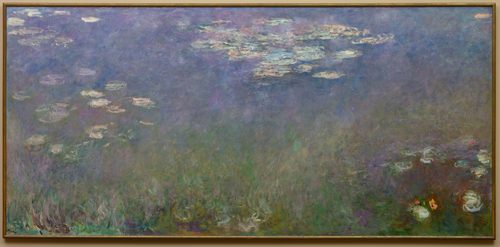
Final decades' large water-lily canvases dissolve reflection, surface, and sky into near-abstract fields of pure color.
Local signatures
How to spot Giverny art
- Water lily pads
- → Monet's constructed pond, the central motif of his final three decades of painting.
- Japanese footbridge
- → The garden's designed focal point, echoing Monet's collection of Japanese woodblock prints.
- Weeping willow branches
- → Framing foliage used to soften and veil reflections across the pond's painted surface.
- Haystacks
- → A recurring rural motif from fields near Giverny, painted in series across changing seasons.
- Poplar row along the Epte
- → A repeated linear motif tracked through shifting light and weather in a dedicated series.
- Rose-covered trellis path
- → The garden's flower alley, a structured perspective device used in Monet's garden views.
The story
Claude Monet moved to Giverny with his family in 1883, purchasing the house outright in 1890 once Impressionism's market improved. He enlarged the garden in the 1890s, buying adjoining land in 1893 to dig the water-lily pond and build the Japanese bridge seen in his later series. From 1890 he worked in tightly sequenced series, Haystacks, then Poplars, then Rouen Cathedral, painted from a rented room rather than at Giverny, fixing the working method his garden paintings would follow for decades. American painters, aware of Monet's reputation, began settling in the neighboring hamlet from around 1887, and by the 1890s a recognized colony of mostly American Impressionists worked there, though Monet kept his own circle small. His eyesight deteriorated through the 1910s-20s from cataracts, and his final Grandes Décorations water-lily panels, begun after 1914, were donated to the French state and installed at the Musée de l'Orangerie in Paris after his 1926 death.
Masterpieces of the place
| Work | Artist | Date | Why it matters |
|---|---|---|---|
| Water Lilies (Nymphéas) series | Claude Monet | 1897-1926 | Decades of pond paintings tracking light and season on the Giverny water garden. |
| The Japanese Footbridge | Claude Monet | 1899 | The garden's designed bridge rendered in high, unmixed color over the lily pond. |
| Haystacks series | Claude Monet | 1890-91 | The series method fixed here was later applied throughout the Giverny garden paintings. |
| Grandes Décorations | Claude Monet | 1914-1926 | Mural-scale water-lily panels donated to the French state, installed at the Musée de l'Orangerie. |
| Wisteria | Claude Monet | 1919-20 | A late, near-abstract garden painting dissolving foliage into fields of pure color. |
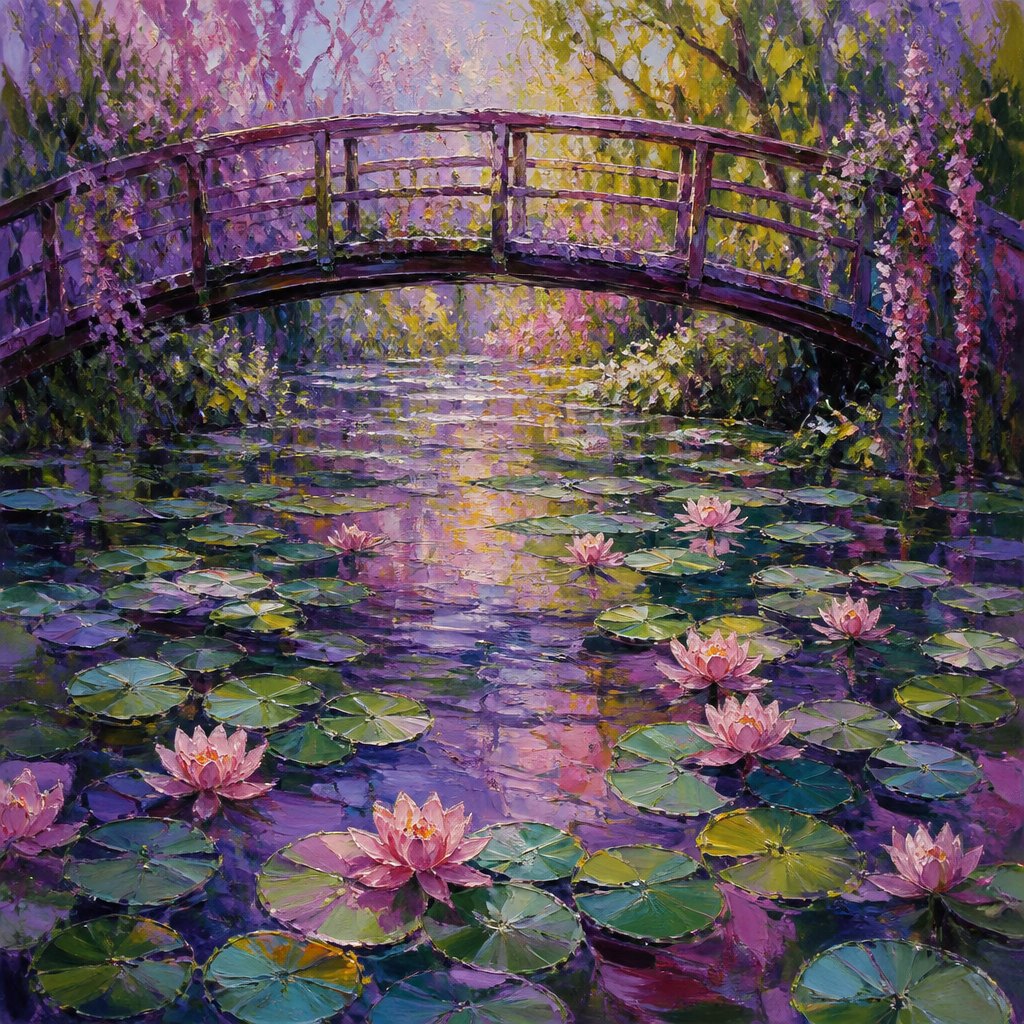 AI-generated
Work en plein air
Paint in the light of Giverny
This example was generated from a prompt like: “A garden pond thick with water lilies beneath a curved wooden footbridge, painted in loaded, unblended strokes of violet, green, and pink that dissolve reflection and surface into shimmering color.”
Open the Giverny Art Style generator →The place today
Monet's house and garden at Giverny are open to the public and maintained to his original planting plans, with the pond and Japanese bridge intact. The Musée des impressionnismes Giverny, opened in 2009 nearby, shows Impressionist and American Impressionist works connected to the colony. Monet's major water-lily cycle remains installed at the Musée de l'Orangerie in Paris. The garden draws large seasonal tourism, especially during summer bloom, continuing as a functioning garden rather than a static site.
Compose your own
Choose one fixed motif, a pond edge, a bridge, a row of trees, and commit to painting it repeatedly under different light rather than varying the subject. Load the brush and lay strokes side by side without fully blending, letting complementary colors sit next to each other so the eye mixes them at a distance. Skip black; render shadow in blue, violet, or green instead. Let reflection and surface merge near water, so solid form dissolves into color patches toward the canvas edges. Work outdoors when possible, adjusting for the specific hour's light rather than an imagined ideal.
Frequently asked questions
Did Monet design the Giverny garden himself?
Yes. He bought adjoining land, diverted a stream to form the pond, and planted specifically with painting in mind, treating the garden as a constructed subject rather than found scenery.
Is Giverny an art school?
No. It functioned as an informal painters' colony with no teaching institution; Monet worked largely alone, while a separate American Impressionist group settled nearby.
Where are Monet's water lilies now?
The largest cycle, the Grandes Décorations, is installed at the Musée de l'Orangerie in Paris; further water-lily canvases are held in museums across Europe and the United States.
Why did American painters settle near Giverny?
Rail access from Paris was easy and cheap, and Monet's established reputation drew painters seeking proximity to his method, forming a distinct colony in the neighboring hamlet from the 1880s.