 Art
Art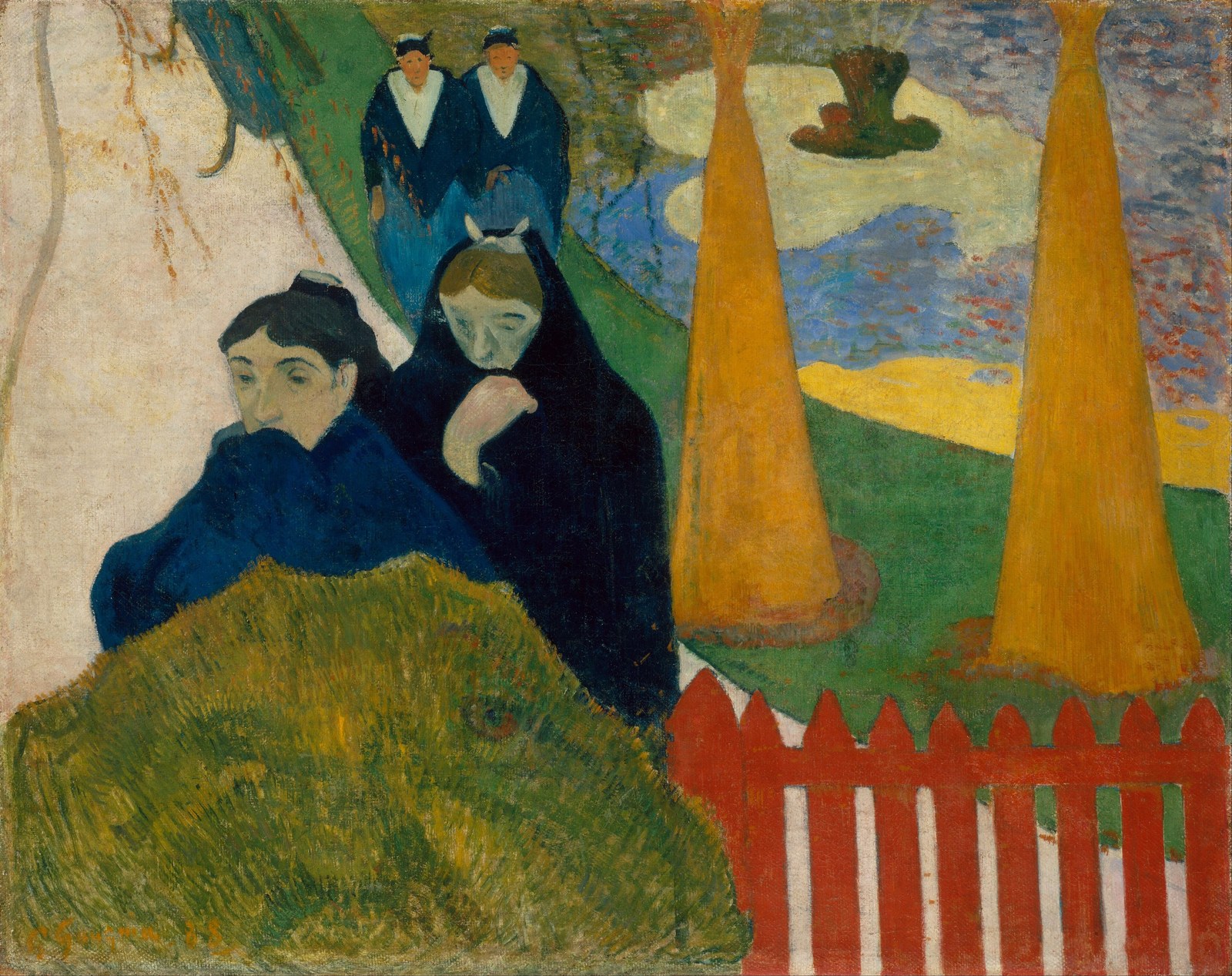
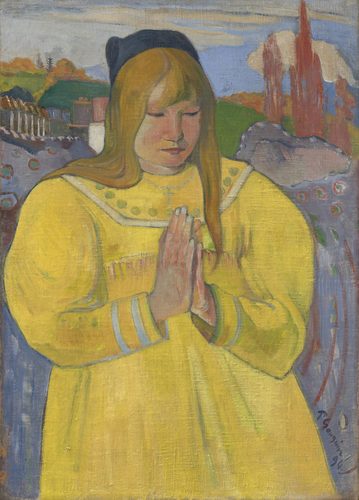
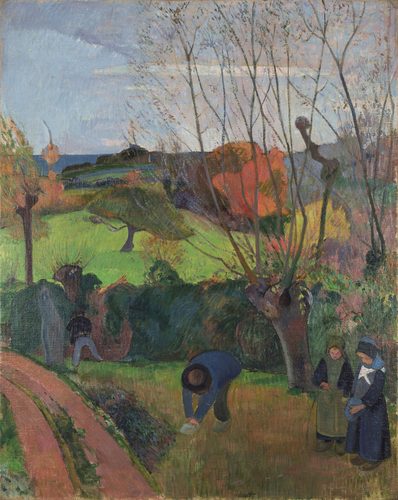
Pont-Aven art refers to the loose group of painters, French and international, who gathered in this small Breton fishing town from the mid-1880s through the 1890s, drawn by cheap lodging, the well-known Pension Gloanec, and a landscape of granite outcrops, calvaries, and Breton peasants in traditional dress that felt untouched by modern Paris. Paul Gauguin arrived in 1886 and again in 1888, working alongside Émile Bernard and later Paul Sérusier, developing Synthetism: painting not what the eye records but what memory and emotion simplify it to, flat planes of unmodulated color bounded by dark outline, nicknamed cloisonnism after enamel work. Brittany's Catholic folk piety, its pardons and calvaries, supplied ready-made subject matter treated as timeless rather than picturesque. No academy or wealthy patron organized the group; it worked as an informal colony sharing a cheap inn and a shared rejection of Impressionist naturalism, and it scattered once Gauguin left for Tahiti in 1891.
What marks the region
Cloisonnism
Flat color fields bounded by heavy dark outlines, borrowed from stained glass and cloisonné enamel, flattening depth deliberately rather than modeling it.
Synthetist simplification
Painting from memory and feeling rather than direct observation, reducing a scene to essential shapes and a few large color zones.
Breton peasant subjects
Women in tall white lace coiffes and dark wool treated as timeless regional types rather than portraits of specific individuals.
Non-naturalistic color
Color chosen for emotional or decorative effect, a red field or yellow tree trunk bearing no relation to the light actually observed.
Communal lodging
Painters lived and worked together at cheap Pont-Aven inns, sharing subjects, models, and technique through constant daily contact.
Religious folk motifs
Calvaries, pardons, and wayside crosses painted as flattened, decorative pattern rather than as conventional devotional narrative.
Local signatures
How to spot Pont-Aven art
- White lace coiffe
- → Marks a figure as a Breton peasant woman; the headdress shape varied by parish and identified local origin.
- Granite wayside cross
- → Brittany's rural Catholic folk piety, rendered as flat decorative shape rather than narrative scene.
- Wooden sabots
- → Peasant labor and rural Brittany, a recurring detail grounding a figure in the region's working life.
- Heavy black outline
- → The cloisonnist signature separating flat color zones, borrowed from enamel and stained-glass technique.
- Flattened haystack or orchard
- → Breton farmland reduced to decorative pattern, color chosen for mood rather than observed light.
- Pardon procession
- → A Breton religious festival gathering, its costumes reused as a set-piece subject for group compositions.
The story
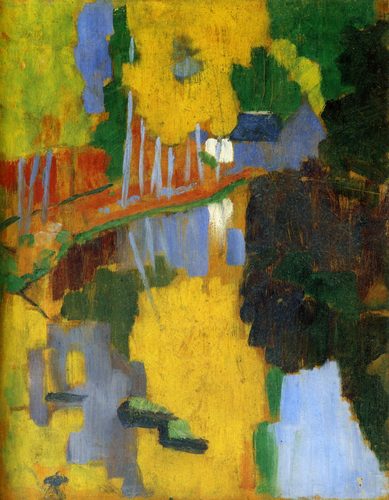
Pont-Aven had already drawn American and British landscape painters by the 1860s-70s for its cheap inns and unspoiled Breton scenery. Paul Gauguin, seeking escape from Paris and the cost of Impressionist life, arrived in 1886 and lodged at the Pension Gloanec. Working through 1888 with Émile Bernard, who had already experimented with flat outlined color nearby, Gauguin arrived at Synthetism, seen in The Vision of the Sermon. Paul Sérusier joined in 1888, and his small panel Le Talisman, painted under Gauguin's direction near the Bois d'Amour, became the founding image for the Nabis group back in Paris. The circle also worked at nearby Le Pouldu from 1889. Gauguin left for Tahiti in 1891, ending the school's most productive phase, though painters continued visiting into the 1890s. The village's association with Gauguin remained fixed in French art history long after the group dispersed.
Masterpieces of the place
| Work | Artist | Date | Why it matters |
|---|---|---|---|
| Vision after the Sermon | Paul Gauguin | 1888 | A flat red field and dark outline mark the first fully realized Synthetist canvas. |
| Le Talisman | Paul Sérusier | 1888 | A small panel painted under Gauguin's direction at the Bois d'Amour, later a Nabis founding image. |
| Breton Women at the Gate | Émile Bernard | 1888 | Cloisonnist outline and flat color applied to Breton peasant figures near Pont-Aven. |
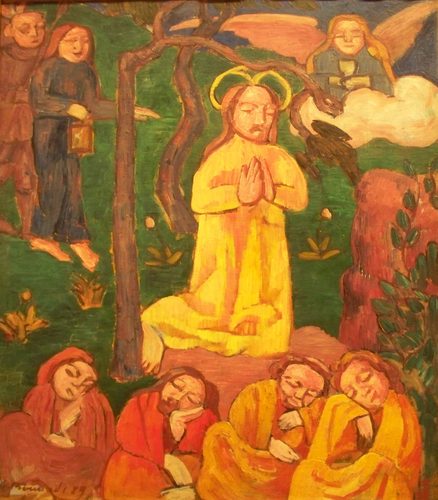
| The Green Christ (Breton Calvary) | Paul Gauguin | 1889 | A wayside calvary flattened into decorative pattern with a Breton peasant figure below. |
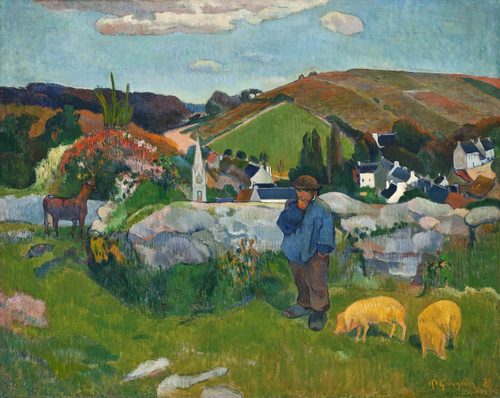
| Harvest: Le Pouldu | Paul Gauguin | 1890 | Non-naturalistic color fields applied to a rural Breton labor scene at the nearby coastal village. |
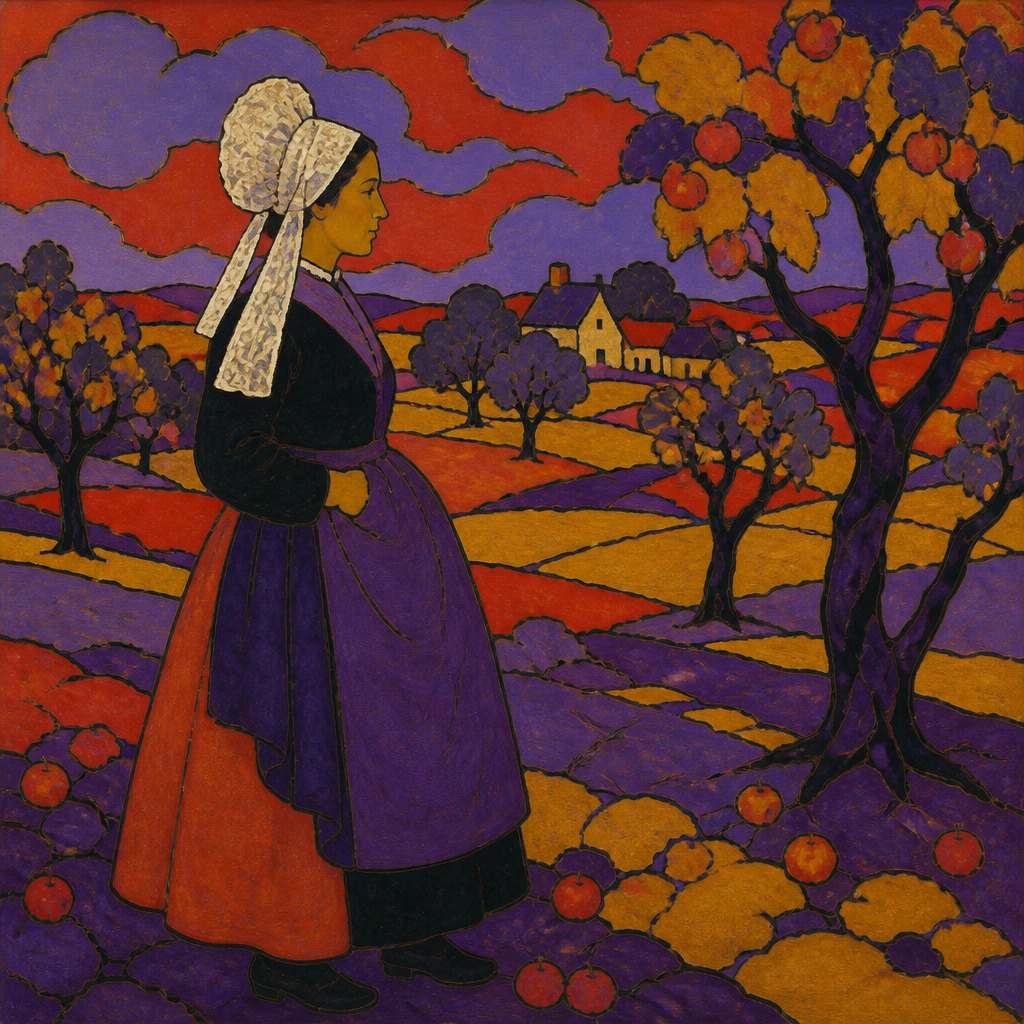 AI-generated
Work en plein air
Paint in the light of Pont-Aven
This example was generated from a prompt like: “A Breton orchard scene with a lace-coiffed peasant figure standing among flattened fields, rendered in bold cloisonnist outlines and non-naturalistic color zones of scarlet, violet, and mustard yellow.”
Open the Pont-Aven Art Style generator →The place today
The Musée de Pont-Aven holds works connected to Gauguin's circle and traces the colony's history in the town itself. The Bois d'Amour path where Sérusier painted Le Talisman remains walkable today. Le Pouldu's inn has been reconstructed as a small museum devoted to the group's second base. The town markets itself around this heritage with an annual arts festival, though it functions primarily as a heritage site for a specific late-1880s moment rather than a center of new painting.
Compose your own
Reduce a Breton landscape or figure to a few flat color zones, choosing color for mood rather than observed light, a scarlet field, a violet trunk, a mustard sky. Outline every shape in dark, even, continuous line, as if leading in stained glass. Include one clearly Breton marker, a white lace coiffe, sabots, a granite cross, treated as pattern rather than portrait. Avoid modeling or shading gradients; let each color zone sit as a single flat plane. Compose with decorative flatness in mind, arranging shapes for pattern across the surface rather than illusionistic depth.
Frequently asked questions
What is Synthetism?
A method developed at Pont-Aven around 1888 in which painters simplified scenes from memory and feeling into flat color zones bounded by dark outline, rather than recording observed light directly.
How does Pont-Aven painting differ from Impressionism?
Impressionists tracked shifting optical light with broken brushwork; Pont-Aven painters flattened color into bounded zones and worked from memory, prioritizing decorative pattern and emotion over observed light.
Why did Gauguin choose Pont-Aven?
It offered cheap lodging at the Pension Gloanec, an unspoiled Breton landscape, and traditional peasant costume he treated as timeless subject matter unavailable in Paris.
Is Pont-Aven the same as the Nabis?
No. The Nabis were a younger Paris group influenced by Sérusier's Le Talisman, painted at Pont-Aven under Gauguin's direction, but they formed and exhibited separately in Paris from 1888 onward.