 Art
Art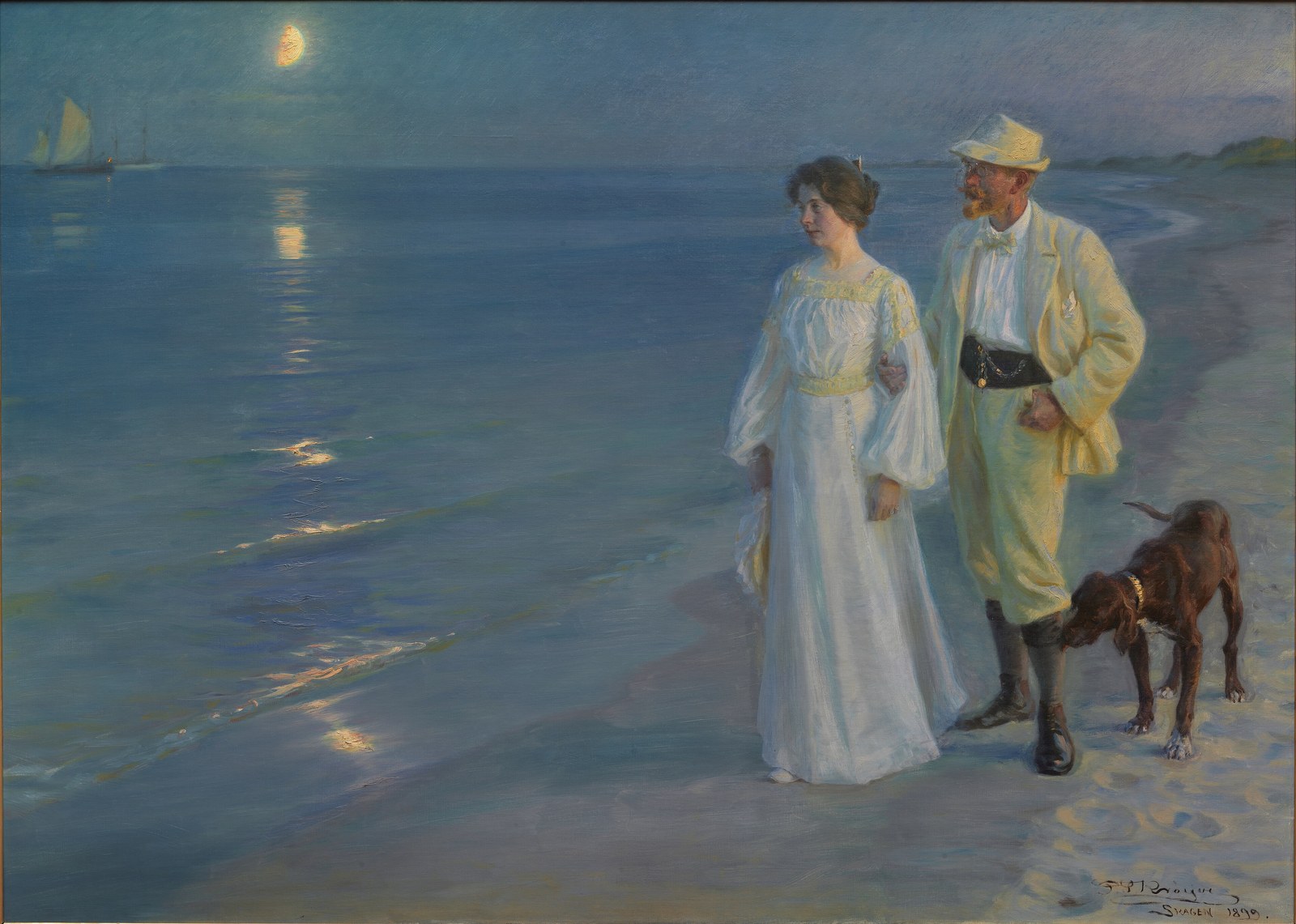
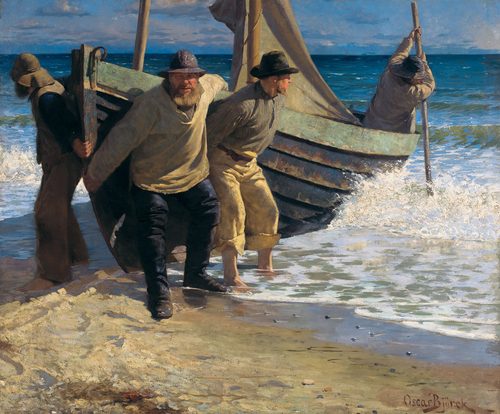
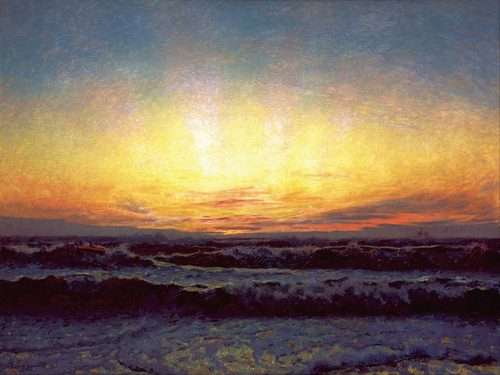
Skagen art refers to the painting colony that formed in the 1870s-1900s at the northern tip of Jutland, Denmark, where the Skagerrak and Kattegat seas meet. Danish and Nordic painters, drawn first by cheap lodging and later by the area's unusual light, gathered around Brøndums Hotel in the fishing village of Skagen. Michael Ancher settled there in 1874 and married local innkeeper's daughter Anna Brøndum, herself a serious painter; P.S. Krøyer arrived in 1882 and became the group's most technically ambitious member. Working outdoors, the painters recorded fishermen hauling boats, women mending nets, and above all the long, saturated dusk locals called the blue hour. There was no royal or church patronage here: buyers were Copenhagen collectors and the artists themselves. Skagen became Denmark's answer to French plein-air painting, fusing Naturalist observation of working people with a distinctly northern, silvery-blue palette found nowhere else in Nordic art.
What marks the region
Plein air fishing scenes
Painters worked outdoors directly among fishermen and dunes, rejecting studio composition in favor of on-the-spot observation of weather, tide, and daily coastal labor.
Skagen blue twilight
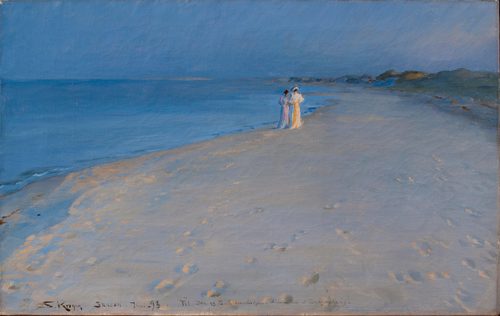
The colony centered on the pale, drawn-out summer dusk unique to Jutland's tip, a cool blue-grey light painters returned to again and again as the school's defining subject.
Brøndums Hotel gatherings
Brøndums Hotel served as informal headquarters, its dining room the site of long communal dinners the painters later depicted as group portraits of their own circle.
Unidealized fisherfolk
Local fishermen and their wives were painted as individuals with weathered hands and worn oilskins, never softened into picturesque peasant types.
Working painter couples
Several core painters were married couples working side by side, producing paired or overlapping views of the same rooms, beaches, and sitters.
Loose Naturalist brushwork
Brushwork stayed visible and unblended, closer to French Naturalism than academic finish, letting sunlight and sand read as texture rather than smooth illusion.
Local signatures
How to spot Skagen art
- Sou'wester oilskins
- → Yellow waxed rain gear worn by fishermen, a working-class counterpart to the fine fabrics of court painting elsewhere in Europe.
- Boats hauled on open sand
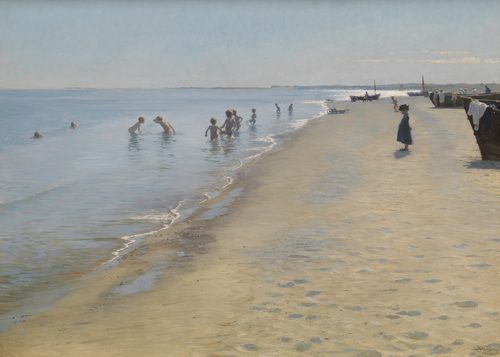
- → Wooden boats pulled directly onto the beach, marking Skagen's identity as a working fishing village, not a resort.
- Long communal dinner table
- → A shared table set for many, standing for the colony's social life and its habit of painting its own circle.
- Marram grass and dunes
- → Wind-bent grass on shifting sand dunes, the flat coastal terrain that gave painters unbroken horizon light.
- Blue dusk sky
- → The extended northern twilight rendered in cool blue-grey tones, the school's most identifiable atmospheric signature.
- White summer dresses
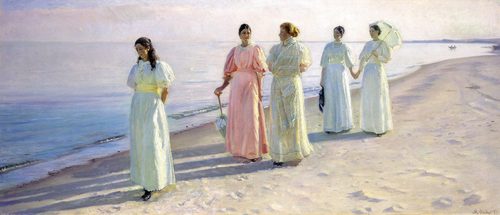
- → Women in pale linen against beach or garden light, used to catch and reflect the low evening sun.
The story
Skagen was a remote fishing village on Jutland's exposed northern tip when Danish and Norwegian painters began arriving in the 1870s, drawn by cheap living and unusual coastal light. Michael Ancher settled there in 1874, marrying Anna Brøndum in 1880; she became one of the group's strongest painters in her own right. P.S. Krøyer joined in 1882, bringing international training and producing large group scenes of the colony at leisure. Writer-painter Holger Drachmann and Norwegian painter Christian Krohg also spent time there, linking Skagen to wider Scandinavian Naturalism. The colony peaked through the 1880s-90s, exhibiting in Copenhagen and gaining national recognition. Tourism and improved rail access after 1900 gradually changed the village, and the informal colony faded as a working community by the 1900s-1910s, though individual painters kept returning. The Skagen Museum, built in 1908 with funds raised by the artists themselves, still holds the core collection.
Masterpieces of the place
| Work | Artist | Date | Why it matters |
|---|---|---|---|
| Hip, Hip, Hurrah! | P.S. Krøyer | 1888 | A large group portrait of the Skagen painters celebrating in a garden, the colony's best-known image. |
| Summer Evening at Skagen Beach | P.S. Krøyer | 1892 | A signature blue-hour beach scene showing the artist's wife and dog by the shore at dusk. |
| Sunlight in the Blue Room | Anna Ancher | 1891 | A domestic interior noted for its subtle, unusually cool color handling. |
| Will He Round the Point? | Michael Ancher | 1879 | Fishermen watching a boat's approach, painted with documentary attention to local labor. |
| A Christening | Michael Ancher | 1888 | A communal fisherfolk ritual rendered with the group's characteristic unidealized realism. |
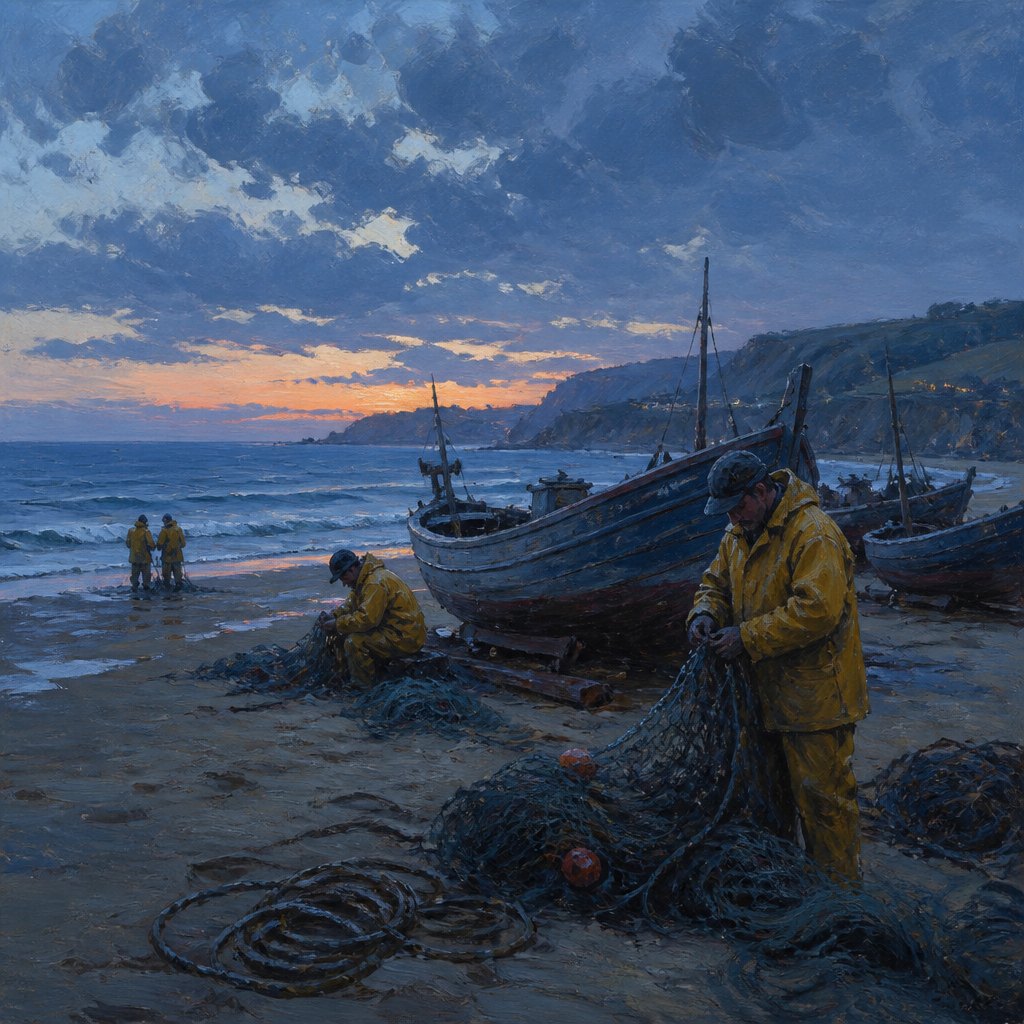 AI-generated
Work en plein air
Paint in the light of Skagen
This example was generated from a prompt like: “A wide sandy beach at dusk with wooden fishing boats pulled ashore, figures in yellow oilskins beside coiled nets, the whole scene washed in cool blue-grey twilight light with visible, loose brushwork.”
Open the Skagen Art Style generator →The place today
The Skagen Museum holds the core collection, from Krøyer's large beach scenes to Anna Ancher's interiors, in the village where they were painted. Brøndums Hotel still operates, its old dining room preserved with portraits of the original circle on its walls. Skagen remains a small fishing town rather than an art capital, its dunes, harbor, and lighthouse largely unchanged, drawing visitors who come to see the actual light the painters chased.
Compose your own
Work outdoors, or simulate it: keep the horizon low and let a wide, flat sky dominate. Push the palette toward cool blue-greys for anything set at dusk; even skin and sand should carry a faint blue cast rather than warm gold. Choose ordinary coastal subjects, boats on sand, nets, a garden dinner, over dramatic incident. Keep brushwork visible and slightly loose rather than polished, closer to direct observation than studio finish. If including figures, dress them in working clothes, oilskins, plain linen, and let weather-worn hands and faces read as real rather than idealized.
Frequently asked questions
What is the Skagen School in Danish art?
A loose colony of Danish and Nordic painters who worked in the fishing village of Skagen from the 1870s to around 1900, known for plein-air scenes of fishermen and the region's distinctive blue twilight light.
Why did painters choose Skagen specifically?
Its position where the Skagerrak and Kattegat meet produces unusually long, pale summer dusks, and the village offered cheap lodging at Brøndums Hotel plus an intact fishing community as subject matter.
Were Michael and Anna Ancher both painters?
Yes. They married in 1880 and both painted professionally; Anna Ancher is now recognized as one of the strongest colorists of the group, working mainly on domestic interiors.
Is the Skagen colony similar to French Impressionism?
It shares plein-air method with French Naturalism and Impressionism but keeps forms more solid and subjects more documentary, focused on named local fishermen rather than anonymous urban leisure.