 Art
Art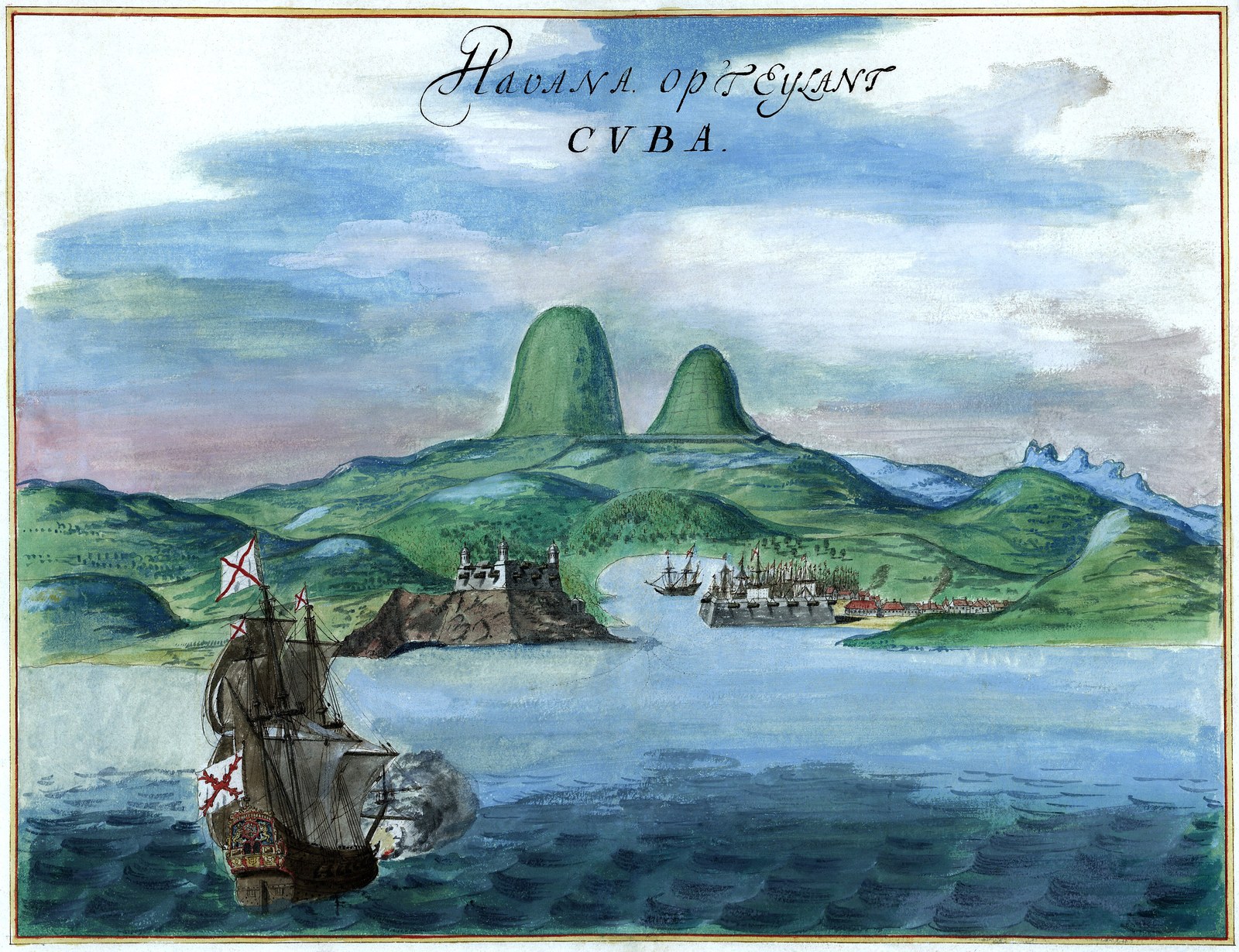
Havana art history spans two distinct eras built on the same tropical port geography. Founded in 1519 and made capital of Spanish Cuba in 1607, the city became the gathering point for the Flota de Indias treasure fleets, and that traffic financed a Baroque building boom from the 1600s through the 1700s. Local quarries near Jaimanitas supplied a soft, honey-colored coral limestone that shaped churches, convents, and civic palaces around Plaza de la Catedral and Plaza Vieja, worked by masons largely without European academic training, producing looser, more asymmetrical facades than Spain's own Baroque. Sugar wealth in the 1800s added neoclassical mansions and wrought-iron balconies. After independence in 1902, Havana absorbed Beaux-Arts and Art Deco fashions culminating in the 1929 Capitolio. Cuban vanguardia painters, trained partly in Paris, staged the landmark 1927 Exposición de Arte Nuevo, trading academic realism for flattened tropical color, Afro-Cuban imagery, and Cubist structure, giving the island its first distinctly modern school.
What marks the region
Coral-stone masonry
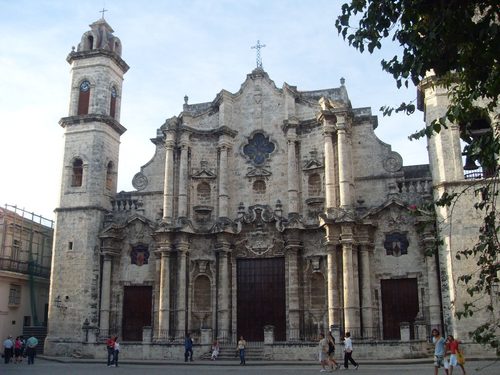
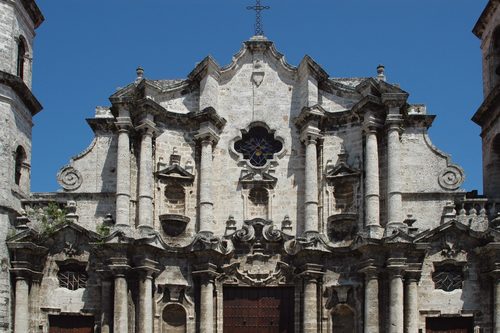
Builders quarried soft, porous limestone from nearby Jaimanitas, easy to carve but quick to weather, giving Havana's Baroque facades their rounded, hand-worked edges rather than crisp European stonework.
Asymmetrical towers
Havana Cathedral and other colonial churches favor two unequal bell towers, a deviation from Iberian Baroque symmetry attributed to local masons working without formal academic training.
Mediopunto and vitrales
Fan-shaped stained-glass transoms above doors and windows scatter colored light across interior tile floors, a tropical adaptation that also cooled and ventilated Havana's deep colonial rooms.
Shaded colonnades
Continuous ground-floor arcades along commercial streets like Calle Obispo shelter pedestrians from sun and sudden rain, a practical Caribbean answer to Spain's open plazas.
Interior courtyards
Colonial townhouses turn inward around a planted patio rather than facing the street, keeping rooms cool and private behind heavy wooden doors and iron window grilles.
Flattened tropical color
Vanguardia painters after 1927 dropped academic modeling for flat planes of saturated color and simplified Afro-Cuban and rural figures, borrowing Cubist structure for local subject matter.
Local signatures
How to spot Havana art
- Mediopunto fanlight
- → Half-moon stained glass over doorways, unique to Havana's colonial houses, filters tropical sun into colored interior light.
- Wrought-iron reja
- → Decorative window grilles marking a house's wealth and era, from simple colonial bars to ornate 19th-century filigree.
- Royal palm
- → Cuba's national tree appears across vanguardia landscapes as shorthand for rural identity and island geography.
- Ceiba tree
- → A tree held sacred in Afro-Cuban Santería, appearing in paintings and public spaces as a marker of syncretic religious life.
- Guajiro figure
- → The rural farmer, rendered in flattened color by vanguardia painters, stood for authentic Cuban identity against academic Spanish taste.
- Coral-stone facade texture
- → Visibly porous, hand-worked limestone surfaces signal genuine colonial-era construction rather than later imitation.
The story
Havana was founded in 1519 on a natural harbor and named capital of Spanish Cuba in 1607, becoming the assembly point for treasure fleets sailing between the Americas and Seville. That traffic funded a Baroque building campaign through the 1600s and 1700s: Havana Cathedral rose between 1748 and 1777, its uneven towers and coral-stone facade typical of masons working outside formal Spanish academies. City walls went up after 1674 for defense against pirates and rival powers. Nineteenth-century sugar wealth added neoclassical mansions and the grand Paseo del Prado. After the 1902 Republic, American investment brought Beaux-Arts civic architecture, crowned by the 1929 Capitolio Nacional, modeled loosely on Washington's Capitol. Cuban painters trained in Europe staged the 1927 Exposición de Arte Nuevo in Havana, launching the vanguardia movement that traded academic realism for Cubist-inflected, tropically colored modern painting. Habana Vieja was declared a UNESCO World Heritage Site in 1982, formalizing decades of restoration work.
Masterpieces of the place
| Work | Artist | Date | Why it matters |
|---|---|---|---|
| Havana Cathedral facade | Unknown | 1748–1777 | Two mismatched coral-stone towers typical of Baroque work by masons outside formal European academies. |
| Castillo de la Real Fuerza | Unknown | 1577 | One of the Americas' oldest surviving colonial forts, marking Havana's early strategic importance. |
| Capitolio Nacional | Eugenio Rayneri Piedra | 1929 | A Beaux-Arts civic monument marking Havana's shift from colonial Baroque to Republic-era grandeur. |
| Palacio de los Capitanes Generales | Unknown | 1791 | The seat of Spanish colonial governors, a landmark of Havana's late Baroque civic architecture. |
| Interior con figura | Fidelio Ponce de León | c. 1934 | A flattened, muted-color canvas typical of the vanguardia generation's break from academic realism. |
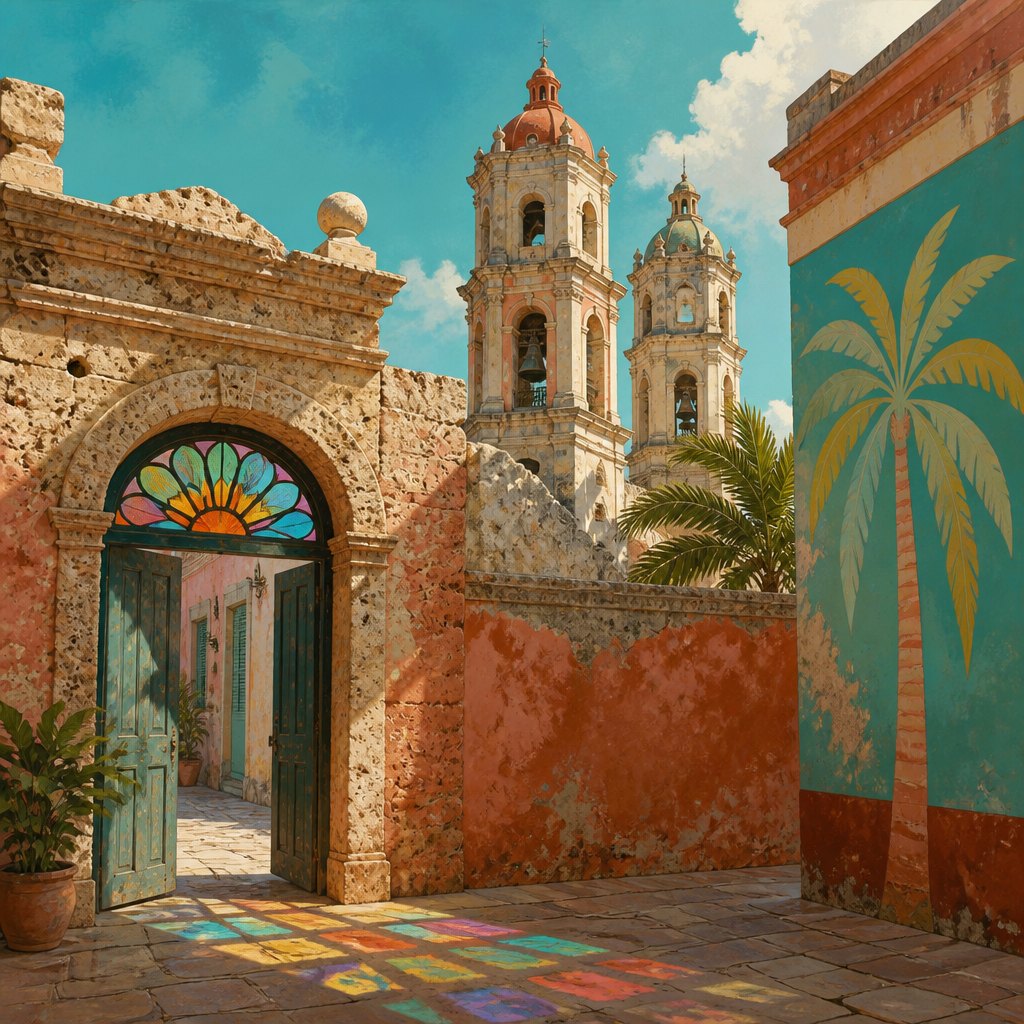 AI-generated
Work en plein air
Paint in the light of Havana
This example was generated from a prompt like: “A weathered coral-stone courtyard in an old port city, an unequal pair of Baroque bell towers behind, a fan-shaped stained-glass transom scattering colored light, and a flattened tropical-color mural of a royal palm on a nearby wall.”
Open the Havana Art Style generator →The place today
Havana Vieja survives as one of the Americas' most intact colonial cores, restored since the 1980s under the Oficina del Historiador de la Ciudad, which funds ongoing masonry and stained-glass conservation. The Museo Nacional de Bellas Artes holds the major vanguardia canvases from the 1927 generation alongside colonial religious art. Plaza de la Catedral, Plaza Vieja, and the Capitolio remain the city's principal architectural landmarks. Traditional trades in coral-stone repair, wrought-iron work, and mediopunto glass persist through restoration workshops training new craftspeople for the historic center.
Compose your own
To evoke Havana's colonial side, work with warm coral-toned stone surfaces left visibly porous and hand-worked, not machine-smooth. Give church facades two unequal towers and let deep colonnaded arcades throw hard shade across a bright plaza. Add a fan-shaped stained-glass transom above a doorway, scattering small patches of red and blue light onto a tiled floor. For the vanguardia side, flatten the same tropical scene into simplified planes of saturated color, drop academic shading, and place a rural figure, a royal palm, or a Ceiba tree at the center with Cubist-simplified structure rather than fine modeling. Keep the palette warm and high-contrast, coral stone against deep tropical greens and cobalt shadow.
Frequently asked questions
What makes Havana's colonial architecture distinct from Spain's own Baroque?
Local masons working without formal academic training used soft coral limestone quarried nearby, producing looser, more asymmetrical facades, like Havana Cathedral's two unequal towers, than symmetrical Iberian models.
What was the Cuban vanguardia movement?
A group of Cuban painters trained partly in Paris who staged the 1927 Exposición de Arte Nuevo in Havana, replacing academic realism with flattened color, Cubist structure, and rural or Afro-Cuban subject matter.
Why is the Capitolio Nacional significant to Havana's art history?
Completed in 1929, it marked Havana's shift from colonial Baroque toward Beaux-Arts and Art Deco civic architecture during the early Republic, funded by early 20th-century sugar and American investment.
Is Havana's historic center protected today?
Habana Vieja was named a UNESCO World Heritage Site in 1982, and the Oficina del Historiador has since directed ongoing restoration of its colonial buildings, stained glass, and ironwork.