 Art
Art
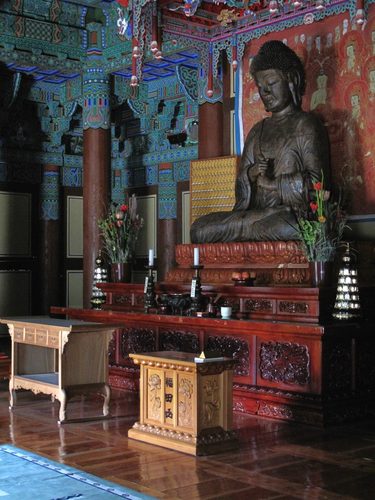
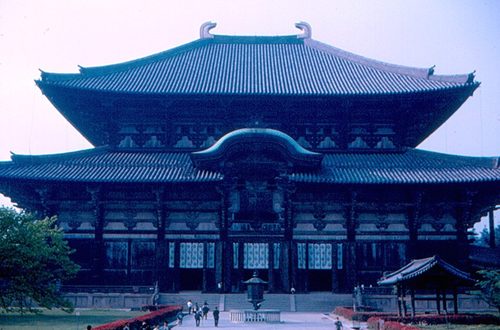

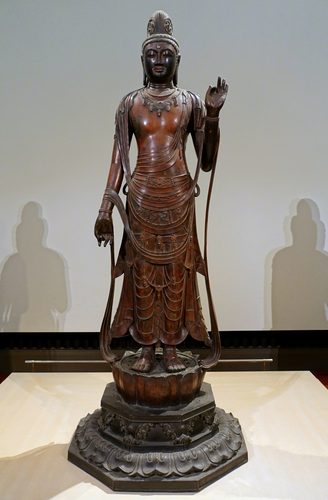
Nara was Japan's first permanent capital, founded in 710 as Heijo-kyo on the grid plan of Tang-dynasty Chang'an, concentrating the court and state-sponsored Buddhism in one city for 84 years. Emperor Shomu used Buddhism as statecraft, ordering provincial temples nationwide and, in 743, a monumental bronze Buddha for Todaiji meant to unify the country under one cosmic order. Casting bronze at that scale required technology imported from Tang China and Korea, as did dry lacquer, a technique building lightweight gilded sculpture from lacquer-soaked cloth over a clay or wooden core. Monks including the Chinese teacher Ganjin, who reached Japan after several failed voyages, carried scripture and craft knowledge directly from the continent, while the imperial Shosoin repository preserved court gifts and ritual objects, some originating along the Silk Road, sealed almost undisturbed for over a thousand years. When the capital moved to Heian-kyo in 794, Nara's temples stayed active, but its era as Japan's political and artistic center ended.
What marks the region
Dry lacquer sculpture
Kanshitsu technique built figures from layers of lacquer-soaked cloth over a wood or clay core, producing lightweight, durable, easily gilded sculpture imported from Tang Chinese practice.
Monumental bronze casting
Todaiji's Great Buddha was cast in sections after repeated attempts, consuming much of Japan's available bronze and copper reserves under direct state supervision.
Nail-free wood joinery
Temple halls and pagodas used interlocking wooden bracket systems without nails, a technique from continental Buddhist architecture that let structures flex and survive earthquakes.
State-sponsored provincial temples
Emperor Shomu ordered a kokubunji temple built in every province, spreading a standardized set of Buddhist images and architectural forms across the country from one capital.
Gilt bronze and gold leaf finish
Major devotional images were finished in gold, whether gilt bronze or gold leaf over lacquer, so that temple interiors glowed by lamplight during ritual.
Continental style transmission
Sculptors and monks arriving from Tang China and the Korean kingdoms brought models directly, giving Nara-period figures a fuller, more naturalistic form than earlier Japanese Buddhist art.
Local signatures
How to spot Nara art
- Vairocana cosmic Buddha
- → The Great Buddha at Todaiji represents the Buddha understood as the universe itself, chosen to symbolize a nation unified under one order.
- Lotus pedestal cosmology
- → Engraved lotus petals beneath the Great Buddha show a diagram of Buddhist cosmology, each petal holding a miniature universe.
- Four Heavenly Kings
- → Armored guardian figures placed at the compass points of a temple, protecting sacred space against demonic intrusion.
- Gate guardian figures
- → Muscular, dynamic figures flanking temple entrances, warding off evil before a visitor reaches the main hall.
- Flame-patterned halo
- → A radiating nimbus behind a Buddhist figure's head, marking spiritual radiance in gilt bronze or carved wood.
- Silk Road treasury objects
- → Musical instruments, glassware, and textiles from Persia, India, and China kept in the Shosoin, marking Nara's place at the end of a long trade network.
The story
Nara became Japan's capital in 710, when the court adopted Heijo-kyo, a city plan copied from Tang China's Chang'an. Emperor Shomu, facing epidemics and unrest in the 730s, responded by expanding state Buddhism, ordering a kokubunji temple in every province in 741 and a monumental bronze Buddha for Todaiji in 743. Casting proved so difficult it required repeated attempts before completion around 749, and the statue's consecration in 752 drew dignitaries and performers from across Asia. In 759 the Chinese monk Ganjin, who had survived five failed sea crossings and lost his eyesight in the effort, founded Toshodaiji to establish a formal ordination platform for Japanese monks. The Shosoin, an imperial storehouse built to hold Emperor Shomu's possessions after his death in 756, preserved court and ritual objects, many arrived via Silk Road trade, essentially untouched for centuries. The capital relocated to Nagaoka in 784 and then to Heian-kyo in 794, ending the Nara period and its concentrated patronage of monumental Buddhist art.
Masterpieces of the place
| Work | Artist | Date | Why it matters |
|---|---|---|---|
| Great Buddha of Todaiji (Vairocana) | Unknown | completed 752 | A monumental bronze Buddha commissioned by Emperor Shomu to symbolize a nation unified under Buddhist order. |
| Horyuji Kondo and five-story pagoda | Unknown | late 7th century | Among the oldest surviving wooden buildings in the world, rebuilt after an early fire using nail-free joinery. |
| Statue of Ganjin | Unknown | c. 763 | A dry lacquer portrait of the blind Chinese monk who founded Toshodaiji, one of Japan's earliest realistic portrait sculptures. |
| Fukukenjaku Kannon | Unknown | c. 748 | A dry lacquer bodhisattva at Todaiji's Sangatsudo hall, its surface built from lacquer-soaked cloth over a wooden armature. |
| Shosoin treasury objects | Unknown | 8th century | Silk Road glassware, musical instruments, and textiles preserved in Emperor Shomu's imperial repository. |
 AI-generated
Work en plein air
Paint in the light of Nara
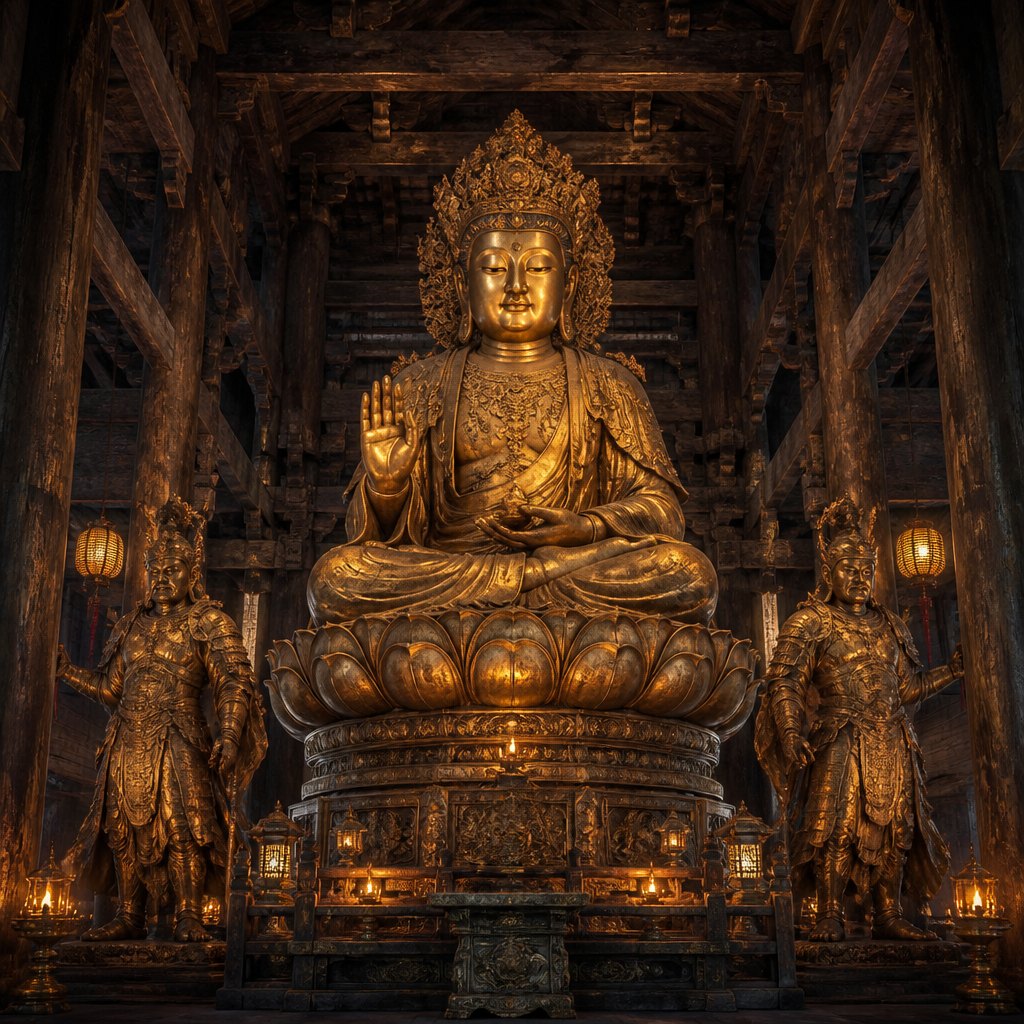
This example was generated from a prompt like: “A monumental gilded bronze figure seated on an engraved lotus pedestal inside a vast wooden hall, flanked by armored guardian statues, warm lamplight catching gold leaf against dark aged wood beams.”
Open the Nara Art Style generator →The place today
Todaiji remains an active temple; its Great Buddha Hall, rebuilt smaller in the Edo period, still houses the original bronze core beneath later repairs. Horyuji, a UNESCO World Heritage Site since 1993, preserves its 7th-century halls largely intact. The Shosoin opens a small selection of its holdings each autumn in a dedicated exhibition at the Nara National Museum, one of the most closely watched events in Japanese museum culture. Toshodaiji and the Nara National Museum's permanent Buddhist art galleries round out a city where temple grounds, deer park, and museum collections sit within walking distance of each other.
Compose your own
Build sculptural form in dry lacquer logic even if working two-dimensionally: smooth, continuous surfaces over a solid core, with drapery falling in calm, rounded folds rather than sharp angularity. Give faces a serene, downcast gaze and fuller, more naturalistic proportions than earlier, flatter Buddhist imagery. Finish major figures in gold, whether gilt bronze sheen or gold leaf over dark lacquer, so they catch lamplight in a dim hall. Surround a central seated figure with a lotus pedestal carrying tiny engraved worlds, and flank the composition with armored, muscular guardian figures in dynamic contrapposto rather than static frontal poses.
Frequently asked questions
Why is Nara considered the start of Japanese Buddhist art?
Nara was Japan's first permanent capital, 710 to 794, where the imperial court used state-sponsored Buddhism and continental building and casting techniques to produce the country's first monumental religious art.
What is the dry lacquer technique used at Nara?
Kanshitsu built sculpture from cloth soaked in lacquer, layered over a clay or wooden core, producing lightweight, gildable figures such as the statue of the monk Ganjin at Toshodaiji.
What is kept in the Shosoin?
An imperial repository built to hold Emperor Shomu's possessions after his death in 756, containing textiles, musical instruments, and Silk Road objects, opened for public viewing only in a limited annual exhibition.
Why did Nara stop being Japan's artistic center?
The capital moved to Nagaoka in 784 and then to Heian-kyo, modern Kyoto, in 794, shifting court patronage and political power away from Nara's temples.