 Art
Art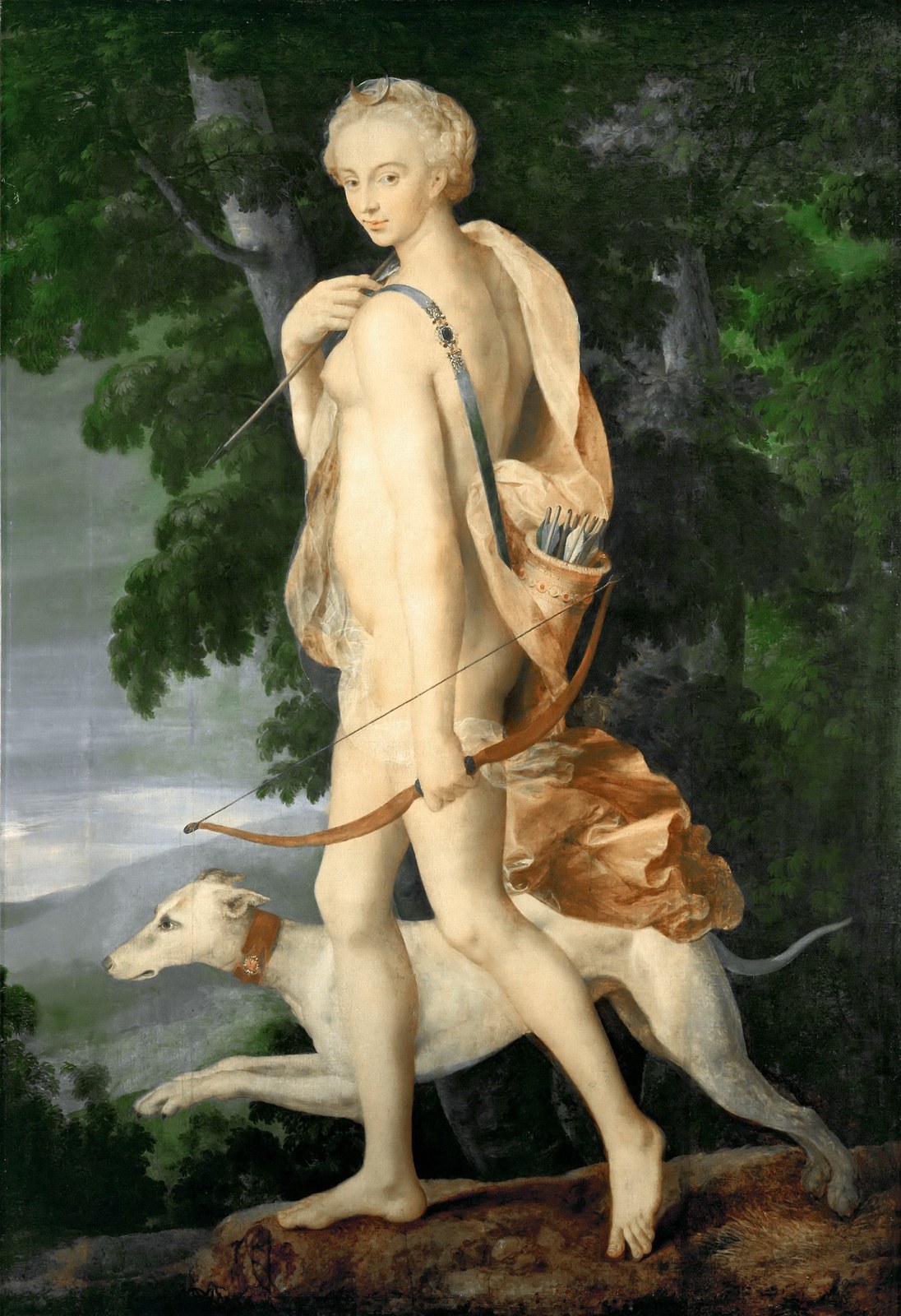
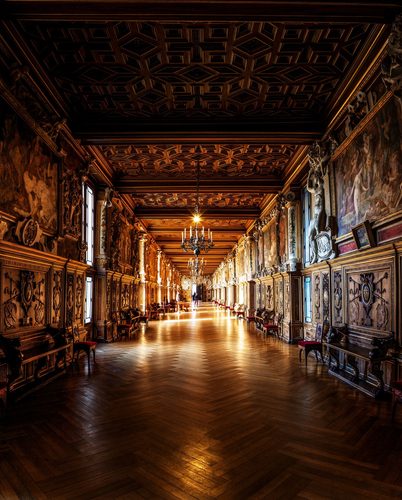

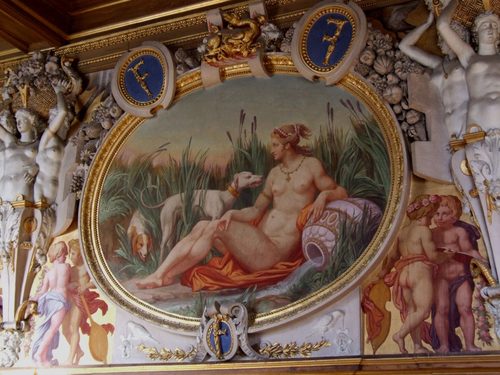
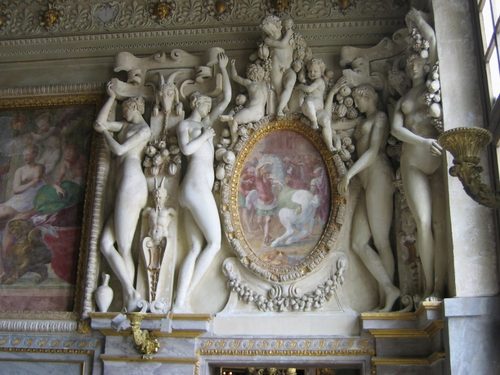
Fontainebleau is the Mannerist decorative school that grew from King Francis I's rebuilding of his forest château south of Paris, beginning in 1528. Wanting a residence to rival Rome, Francis imported Italian artists rather than relying on local guild painters: Rosso Fiorentino arrived in 1530, followed by Primaticcio in 1532, bringing a Florentine and Emilian Mannerism unseen north of the Alps. Their signature innovation was structural, not just pictorial, fusing painted panels with sculpted stucco frames, garlands, and elongated nude figures into single continuous wall schemes, most famously the Gallery of Francis I. There was no local fresco tradition to draw on and no royal academy yet to enforce rules, so the school improvised its own hybrid vocabulary of strapwork ornament, allegory, and cool porcelain-toned flesh. Because the palace served royal rather than church commissions, its imagery wove Francis into scenes of gods and heroes. Engravings of the interiors circulated fast, carrying Fontainebleau's ornamental grammar across France, the Netherlands, and Germany.
What marks the region
Stucco-and-fresco fusion
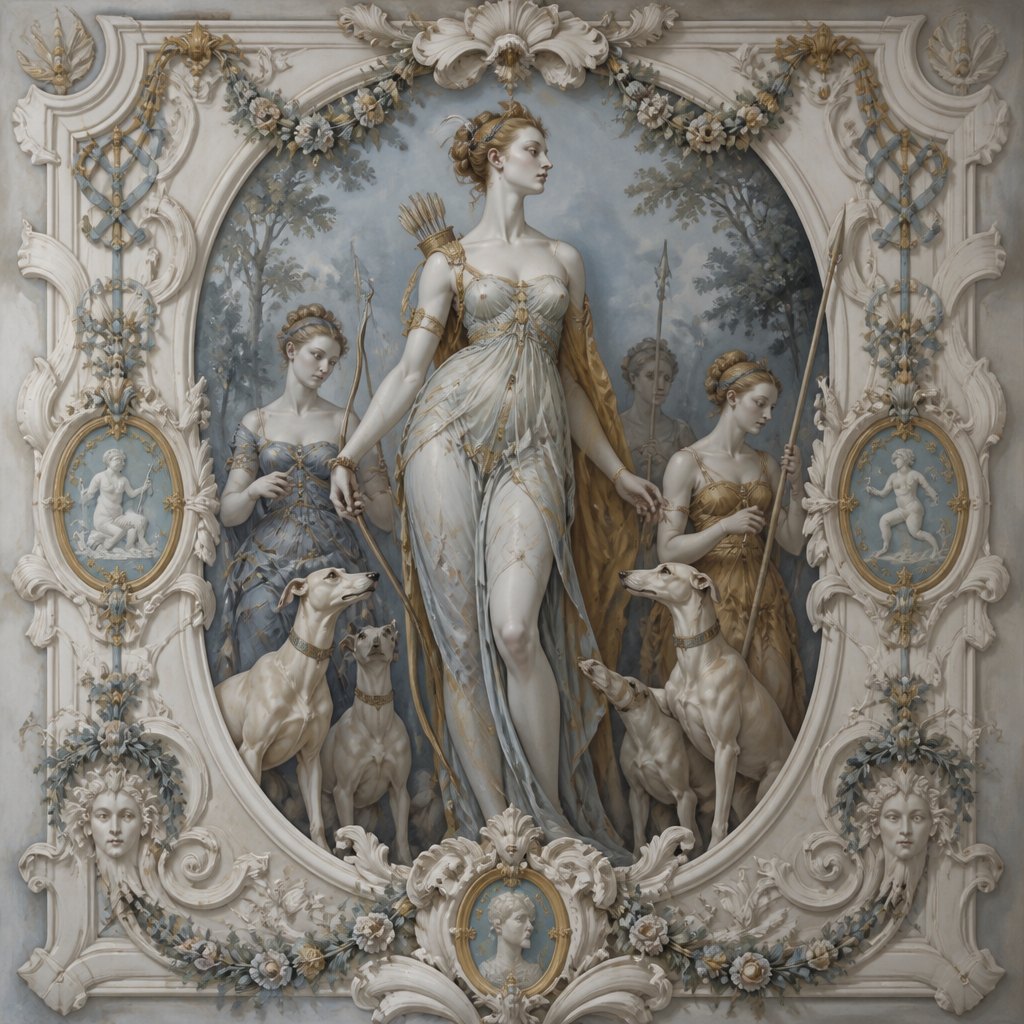
Painted panels sit inside sculpted stucco frames of garlands, strapwork, and reclining nude figures, so painting and relief work as a single continuous wall rather than separate media.
Elongated Mannerist figures
Bodies stretch beyond natural proportion, with small heads, long limbs, and cool, smooth flesh, a Florentine and Emilian habit imported wholesale rather than developed locally.
Strapwork ornament
Cartouches shaped like curling, folded leather frame scenes and inscriptions, an ornamental device the school invented and spread across northern Europe.
Royal allegory
Mythological and classical scenes double as coded portraits of Francis I and his court, casting the king as Mars, Alexander, or a shepherd god within the same fresco cycle.
Print dissemination
Engravers copied the palace's interiors into printed sheets sold across Europe, letting a private royal decoration become the shared pattern book of northern Mannerism.
Long gallery format
Decoration unfolds along a single extended corridor rather than a centralized dome or altar wall, a format built for royal processions and private display rather than worship.
Local signatures
How to spot Fontainebleau art
- Royal salamander
- → Francis I's personal emblem, a crowned salamander in flames, worked into stucco and fresco borders throughout the palace.
- Strapwork cartouche
- → Curling faux-leather frames marking a scene as Fontainebleau in origin, later copied across Antwerp and German ornament prints.
- Elongated female nude
- → The cool, small-headed nude figure, often personifying a virtue or river, signals the school's Florentine-Emilian Mannerist inheritance.
- Diana the huntress
- → A recurring mythological stand-in tied to the palace's own Diana gallery and to royal mistresses cast in her image.
- Garland swags
- → Sculpted fruit and flower garlands link separate painted panels into one continuous decorative field.
- Oval cartouche portrait
- → Framed oval insets holding a mythologized likeness of a court figure within a larger allegorical scene.
The story
Francis I began rebuilding the medieval hunting lodge at Fontainebleau in 1528, intending a palace that could compete with the courts of Rome and Florence. In 1530 he brought Rosso Fiorentino from Italy, followed in 1532 by Francesco Primaticcio, and the two led decoration of the Gallery of Francis I between roughly 1533 and 1539, the work usually credited with founding the school. Primaticcio, joined by Niccolò dell'Abbate from 1552, decorated the Ballroom and other state rooms after Rosso's death in 1540, refining the fused stucco-and-fresco system into its mature form. Prints reproducing the interiors spread the style to Antwerp, Prague, and imitators across France. Following the Wars of Religion, Henri IV revived the workshop from the 1590s, engaging Ambroise Dubois and Toussaint Dubreuil in what historians call the Second School of Fontainebleau, extending the same decorative language into the early 1600s before French taste turned toward classicism.
Masterpieces of the place
| Work | Artist | Date | Why it matters |
|---|---|---|---|
| Gallery of Francis I decoration | Rosso Fiorentino | 1533-1539 | Fused stucco and fresco cycle that founded the school's hybrid decorative system. |
| Ballroom (Salle de Bal) frescoes | Primaticcio and Niccolò dell'Abbate | 1552-1556 | Continued the gallery's fusion of painting and stucco into the palace's grandest state room. |
| Diana the Huntress | School of Fontainebleau | c. 1550 | An elongated nude goddess typifying the school's cool Mannerist ideal, now in the Louvre. |
| Gabrielle d'Estrées and One of Her Sisters | School of Fontainebleau | c. 1594 | Second School double portrait whose flat clarity became one of the era's best-known images. |
| Stucco figures of the Gallery of Francis I | Rosso Fiorentino | 1535-1537 | Sculpted nude figures flanking the frescoes, blending relief and paint into one wall surface. |
 AI-generated
Work en plein air
Paint in the light of Fontainebleau
This example was generated from a prompt like: “An elongated mythological huntress and attendants set within a stucco-framed gallery of garlands and strapwork cartouches, cool porcelain flesh tones, formal Mannerist composition.”
Open the Fontainebleau Art Style generator →The place today
The Palace of Fontainebleau, a UNESCO World Heritage Site, preserves the Gallery of Francis I and the Ballroom largely intact, letting visitors read the school's fused stucco-and-fresco system exactly as courtiers once did. The Musée National du Château conserves the interiors and mounts exhibitions on the school's prints and drawings. Unlike Paris, Fontainebleau today functions as a heritage and conservation site rather than a working artistic center, its influence carried on mainly through the ornamental vocabulary it left in decorative arts collections across Europe.
Compose your own
Begin by treating painting and sculpture as one surface: frame a mythological scene with sculpted stucco garlands, strapwork cartouches, and reclining nude figures rather than a plain painted border. Elongate figures slightly beyond natural proportion, keep flesh tones cool and smooth, and give faces small, composed features. Choose a classical or mythological subject that can carry a coded compliment to a patron, a shepherd god or huntress standing in for a real courtier. Run the composition along a long horizontal band rather than a centered altarpiece format, and let garlands or strapwork bridge each panel into the next so the wall reads as a single ornamental field.
Frequently asked questions
What is the Fontainebleau School?
A Mannerist decorative style developed at the French royal palace from the 1530s, led by imported Italian artists who fused painted panels with sculpted stucco frames, elongated figures, and mythological allegory.
Why did Francis I hire Italian artists instead of French painters?
France had no local Mannerist or large-scale fresco tradition, and Francis wanted a palace that visibly rivaled Rome and Florence, so he recruited Rosso Fiorentino and Primaticcio directly from Italy.
What is the difference between the First and Second School of Fontainebleau?
The First School, under Rosso and Primaticcio from the 1530s-1550s, established the fused stucco-fresco style; the Second, under Ambroise Dubois and others from the 1590s, revived it under Henri IV in a flatter, cooler manner.
Did the Fontainebleau School influence art outside France?
Yes. Engravings of the palace's interiors circulated widely, spreading its strapwork ornament and elongated figure style to Antwerp, Prague, and other northern Mannerist centers.