 Art
Art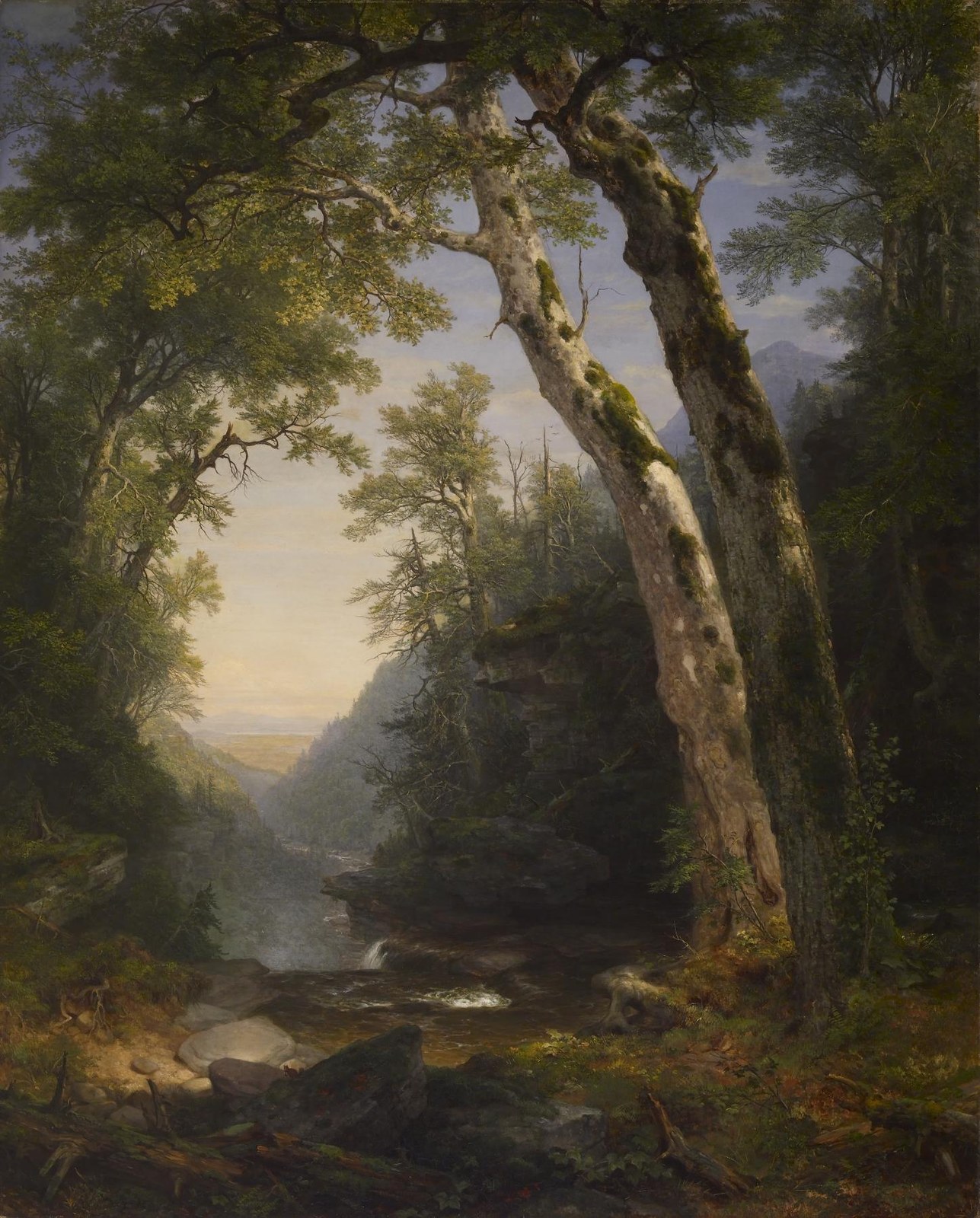
The Hudson Valley school is America's first native landscape tradition, a mid-19th-century movement centered on the Hudson River's gorges, the Catskill Mountains, and the Palisades that treated undeveloped American wilderness as a subject worthy of the grand scale European painters reserved for religious and historical scenes. Thomas Cole, an English immigrant who settled in Catskill, New York, founded the school on the conviction that America's wild, unlogged forests were themselves a form of national scripture — proof of a young country's moral and providential destiny, since Europe's landscapes had long since been tamed by history. His students and followers, including Asher Durand and Frederic Edwin Church, refined the formula: panoramic composition, minutely observed foliage and rock, and a light effect pulling the eye toward a distant, almost sacred horizon. The school's second generation pushed the geography outward, following patrons and railroads to the White Mountains, Niagara Falls, and eventually South America and the Arctic, but the core subject stayed constant — wilderness as evidence of divine and national purpose.
What marks the region
Panoramic composition
Wide, often near-cinematic canvases stage a small human presence against vast terrain, making scale itself the argument for wilderness's grandeur.
Minute botanical detail
Foreground rocks, ferns, and tree bark are rendered with near-scientific precision, a habit borrowed from period natural history illustration.
Providential light
A glowing, often golden light breaks through cloud toward a distant horizon, standing in for divine sanction of the American landscape.
The solitary or paired figure
A tiny hiker, hunter, or guide is included mainly for scale, rarely as a psychological subject in its own right.
Large-format exhibition canvas
Ambitious works were painted big and exhibited singly, ticketed like theater, to compete with European history painting.
Untamed water
Waterfalls, rapids, and river gorges recur as the clearest visual proof that a landscape remains unconquered by settlement.
Local signatures
How to spot Hudson Valley art
- Blasted or dead tree
- → A common device signaling nature's own violent history, independent of any human intervention.
- Distant golden horizon
- → Stands for providence — light breaking specifically over unsettled land reads as divine approval of American expansion.
- Tiny human figure dwarfed by scenery
- → Establishes scale while asserting that wilderness, not settlement, is the true subject.
- Waterfall or gorge
- → Marks land too rugged to farm, prized precisely because it resists development.
- Storm cloud beside clear sky
- → A split-sky device contrasting nature's destructive and benevolent faces within a single frame.
- Peak autumn foliage
- → Signals a specifically American season — European forests don't turn the same way — and became a patriotic visual shorthand.
The story
Thomas Cole arrived in the United States in 1818 and, after sketching trips up the Hudson in the 1820s, produced wilderness views that found an immediate market among New York's new merchant class, who wanted American subjects to hang beside their European imports. Cole settled permanently in Catskill, New York, and by the 1830s had drawn a circle of followers, chief among them the engraver-turned-painter Asher Durand, who formalized the group's aesthetic after Cole's death in 1848 with paintings like Kindred Spirits. Frederic Edwin Church, Cole's only formal pupil, pushed the school toward spectacle, touring South America and Newfoundland for subjects and painting Niagara Falls and volcanic eruptions at a scale meant to draw paying crowds. The Civil War and the closing of the literal frontier eroded the school's founding myth of untouched wilderness, and by the 1880s taste had shifted toward French-influenced Barbizon tonalism and Impressionism, ending the movement's dominance even as its Catskill and Hudson River sites remained popular painting grounds.
Masterpieces of the place
| Work | Artist | Date | Why it matters |
|---|---|---|---|
| View from Mount Holyoke (The Oxbow) | Thomas Cole | 1836 | A split composition sets wild storm-lashed wilderness against a cultivated valley, staging the school's central argument in one canvas. |
| Kindred Spirits | Asher Durand | 1849 | Painted as a memorial to Cole, it places two figures on a Catskills ledge, cementing the school's romantic self-image. |
| Heart of the Andes | Frederic Edwin Church | 1859 | Exhibited alone behind velvet curtains for a paid ticket, this South American panorama shows the school's spectacle-scale endgame. |
| Lake George | John Frederick Kensett | 1869 | A calmer, more luminist take on the same regional light, showing the school's late softening toward stillness. |
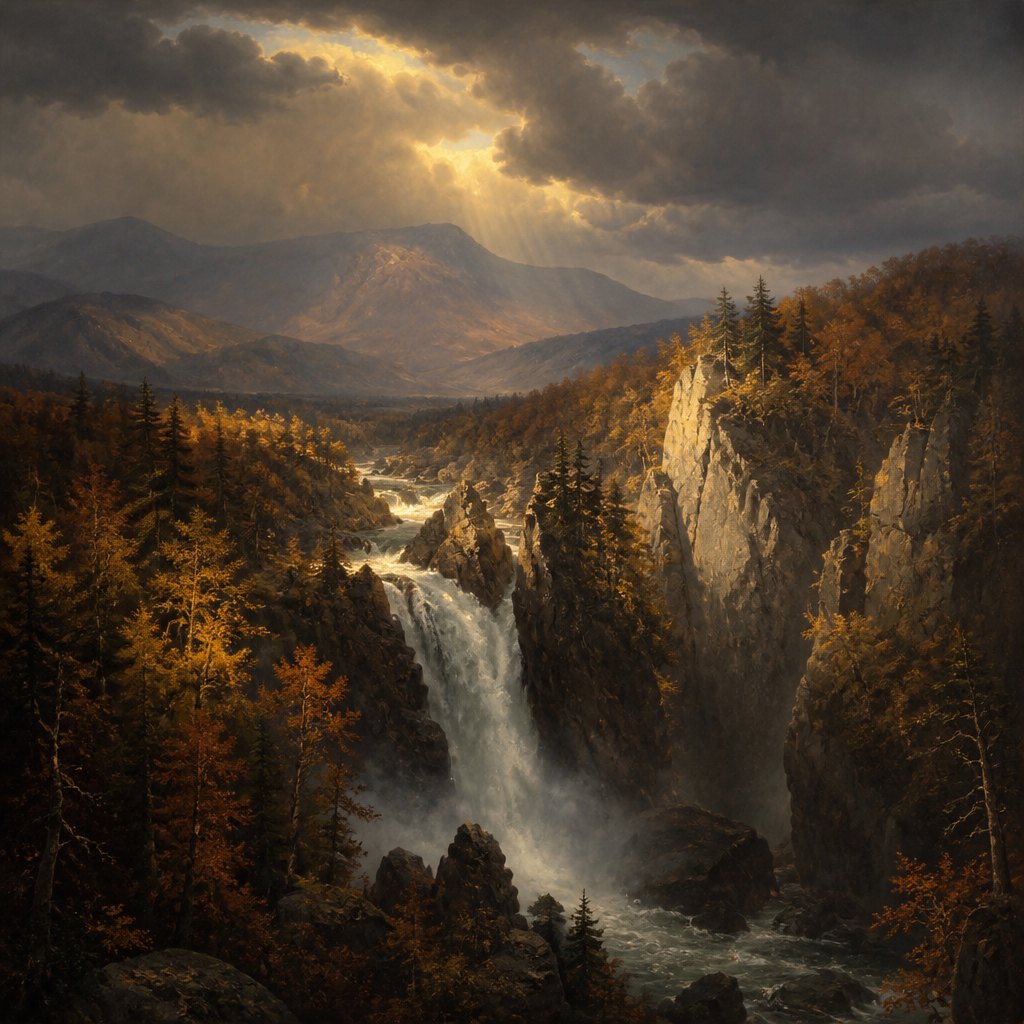 AI-generated
Work en plein air
Paint in the light of Hudson Valley
This example was generated from a prompt like: “A wide wilderness gorge with a roaring waterfall, dense autumn forest in gold and rust, jagged rock ledges catching a break of golden light through storm clouds, distant hazy mountain ridge, no structures, panoramic 19th-century landscape composition.”
Open the Hudson River School Art Style generator →The place today
The Thomas Cole National Historic Site and Olana, Frederic Church's Persian-inspired estate across the river, anchor a working heritage circuit in Catskill and Hudson, New York, drawing landscape painters and photographers back to the same gorges and river bends. The Hudson Valley remains one of the most-painted stretches of American river, now shared with contemporary land artists and ceramicists, and a gallery scene built around Beacon's Dia:Beacon, even as most working painters today favor abstraction over the school's panoramic realism.
Compose your own
Pick a subject that reads as untouched — a gorge, waterfall, or dense treeline rather than a farmed valley — and compose it wide, with a small figure or animal included only to establish scale against the terrain. Build the picture around one strong light source breaking through cloud toward a distant point, since that glow carries the sense of grandeur more than any single detail can. Render foreground rock and foliage with careful, almost botanical precision, then let the middle and far distance soften into atmospheric haze. Keep colors true to season rather than idealized — the strongest autumn scenes work because the color is real, not invented. Avoid visible signs of settlement; the wilderness has to look genuinely unclaimed.
Frequently asked questions
What is the Hudson River School?
America's first coherent landscape painting movement, active roughly 1825-1880, centered on the Catskills and Hudson Valley. It treated unspoiled American wilderness as proof of the young nation's moral and providential destiny, painted at grand, exhibition-ready scale.
Why does the school matter historically?
It gave the United States its first native art movement independent of European academies, and its romantic view of wilderness helped build early public support for landscape preservation, including the national park idea decades later.
Who founded the movement?
Thomas Cole, an English-born immigrant who settled in Catskill, New York, founded the school in the 1820s. His friend and follower Asher Durand and his pupil Frederic Church carried it through its peak decades.
Why did the movement decline?
By the 1870s-80s, American taste shifted toward French Barbizon tonalism and Impressionism, and the closing frontier made the school's untouched-wilderness myth feel dated rather than urgent.