 Art
Art
Düsseldorf is the Rhineland city whose academy trained more than a century of landscape and history painters, then reinvented itself as a center for conceptual photography. Reorganized under Peter von Cornelius in 1819 and expanded under Wilhelm von Schadow from 1826, the Düsseldorf Academy built a rigorous training pipeline that produced the Düsseldorf School's blend of fine detail and theatrical, dramatic landscape and genre painting through the mid-nineteenth century. Brothers Andreas and Oswald Achenbach became its landscape stars, while American students, including Emanuel Leutze, Albert Bierstadt, and Worthington Whittredge, trained or worked there and carried the style home, shaping the Hudson River School's own dramatic vistas; Leutze even painted "Washington Crossing the Delaware" in his Düsseldorf studio in 1851. The school's influence faded by the century's end as Impressionism and the Secessions pulled attention elsewhere, until Joseph Beuys began teaching at the Academy in the 1960s and Bernd and Hilla Becher built a rigorous, typological photography program there.
What marks the region
Meticulous academic finish
Fine, smooth detail in foliage, rigging, and rock strata reflected the Academy's rigorous, repetitive life-drawing training.
Theatrical dramatic light
Storms breaking over sunlit foregrounds, moonlit coastlines, and Alpine drama gave landscapes a legible emotional charge.
Legible narrative painting
History and genre scenes were built around a single recognizable story moment a viewer could read at a glance.
Idealized foreign scenery
Painters favored dramatic Alpine, Norwegian, or Italian views over quieter local motifs closer to home.
Exported training pipeline
The Academy's technical curriculum drew international students, especially Americans, who carried its style back across the Atlantic.
Later photographic rigor
A twentieth-century photography program brought the same discipline to deadpan, large-format, typological images of industrial structures.
Local signatures
How to spot Düsseldorf art
- Storm-lit sea or mountain vista
- → the Achenbach brothers' theatrical drama, contrasting shadow against breaking sunlight
- Heroic river crossing
- → American-subject history painting made in a Düsseldorf studio, most famously Leutze's Delaware crossing
- Moonlit ruin or coastline
- → a Romantic-tinged genre staple favored by the school's landscape painters
- Precise industrial facade or water tower
- → the later Becher-school typological eye applied to overlooked structures
- Tavern or peasant genre vignette
- → narrative anecdote painting built around a single readable incident
- Grid of repeated structures
- → the Becher-trained photographers' serial, deadpan documentation method
The story
The Düsseldorf Academy reorganized under Peter von Cornelius in 1819 and expanded under Wilhelm von Schadow from 1826, building a rigorous training pipeline that produced fine detail joined to theatrical, dramatic landscape and genre painting through the mid-nineteenth century. Brothers Andreas and Oswald Achenbach became the school's landscape stars, painting storm-lit seas and Italianate views. American students, including Emanuel Leutze, Albert Bierstadt, and Worthington Whittredge, trained or worked in Düsseldorf and carried its dramatic, detailed style home, shaping the Hudson River School; Leutze painted "Washington Crossing the Delaware" in his own Düsseldorf studio in 1851. The school's influence faded by the century's end as Impressionism and the German Secessions pulled attention elsewhere. It resurfaced in a different form in the 1960s and 1970s, when Joseph Beuys taught at the Academy and Bernd and Hilla Becher established a rigorous, typological photography program that trained Andreas Gursky, Thomas Struth, and other photographers who now command some of the medium's highest prices.
Masterpieces of the place
| Work | Artist | Date | Why it matters |
|---|---|---|---|
| Washington Crossing the Delaware | Emanuel Leutze | 1851 | An American history subject painted entirely in Leutze's Düsseldorf studio. |
| Clearing Up After a Coast Storm | Andreas Achenbach | 1850s | Dramatic marine light-and-shadow contrast typical of the school's landscape stars. |
| View of Naples | Oswald Achenbach | c. 1870s | A warm, theatrical Italianate scene reflecting the school's taste for foreign drama. |
| Water Towers | Bernd and Hilla Becher | 1960s-90s | Serial, deadpan photographs of industrial structures that founded the later Düsseldorf photography school. |
| Rhine II | Andreas Gursky | 1999 | A large-format, stripped-down river view descending directly from Becher-school training. |
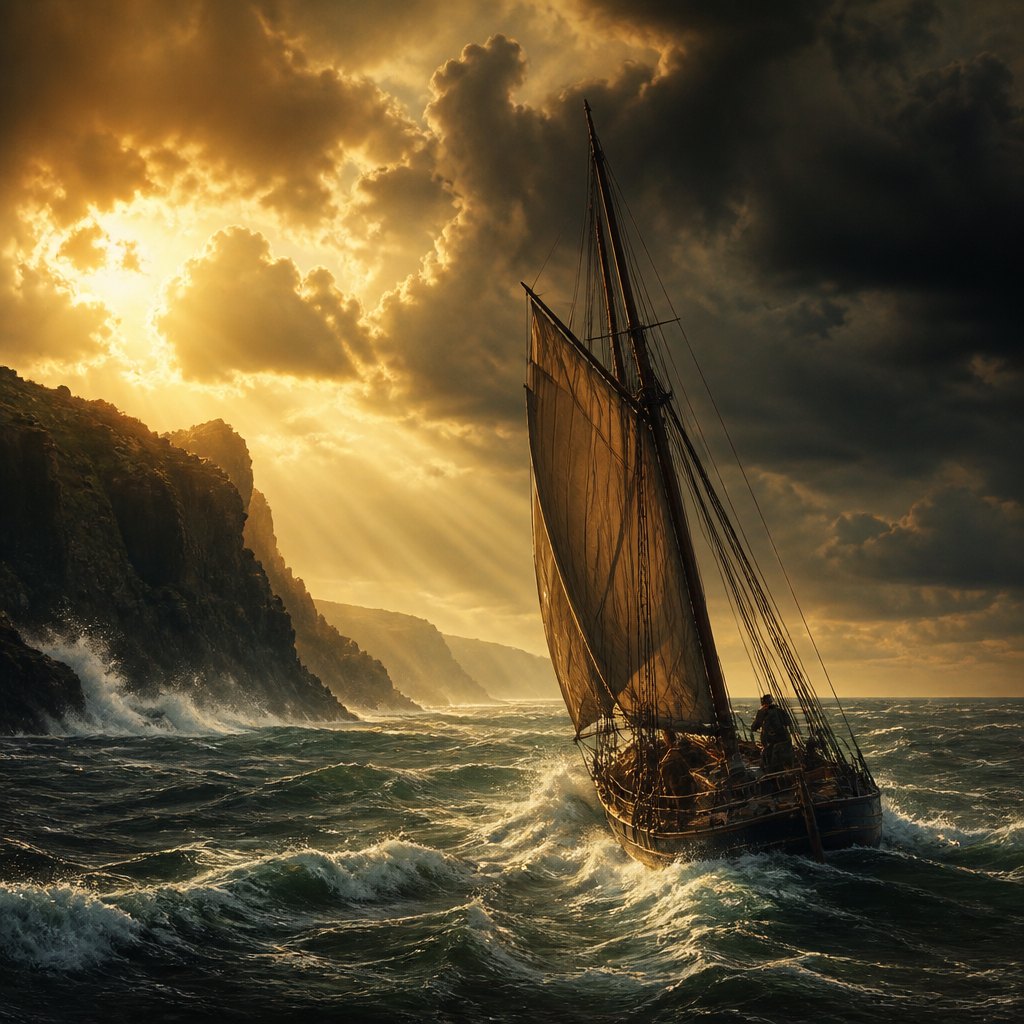 AI-generated
Work en plein air
Paint in the light of Düsseldorf
This example was generated from a prompt like: “A dramatic coastal scene at the edge of a storm, sunlight breaking through dark clouds over churning waves and distant cliffs, meticulously detailed rigging on a small sailing vessel, rich theatrical contrast between deep shadow and golden light.”
Open the Düsseldorf School Art Style generator →The place today
The Kunstakademie Düsseldorf remains a major art school, its Becher-trained photographers, Andreas Gursky, Thomas Struth, Candida Höfer, and Thomas Ruff among them, now commanding some of photography's highest auction prices. The Kunstpalast covers the nineteenth-century painting school's history, while K20 and K21 handle later modern and contemporary collections, giving the city two distinct art-historical identities under one roof of institutions.
Compose your own
Train the eye through repetitive, disciplined life drawing before attempting any finished composition. Build dramatic contrast between a lit foreground incident and a stormy or shadowed sky behind it. Keep every detail, rigging, foliage, rock strata, crisply legible rather than loose or suggested. Choose a recognizable narrative moment a viewer can read at a glance without a caption. For a more contemporary approach, photograph a subject straight-on and without embellishment, then repeat it as a typological series. Let the repetition itself, rather than any single image, become the composition's real subject.
Frequently asked questions
Why is Düsseldorf associated with American landscape painting?
Its academy trained or influenced key American painters, Emanuel Leutze, Albert Bierstadt, and Worthington Whittredge among them, who carried the school's dramatic, detailed style home and helped shape the Hudson River School.
Where was 'Washington Crossing the Delaware' actually painted?
In Leutze's studio in Düsseldorf in 1851, not in America. He was living and working there as part of the city's international academy community when he painted the iconic American scene.
What made the Düsseldorf School's landscapes distinctive?
A combination of meticulous academic finish and theatrical drama, storms, dramatic light, legible narrative incident, taught through the Academy's rigorous training pipeline under Wilhelm von Schadow from 1826 onward.
Is Düsseldorf still an art center today?
Yes, in a different key. Its Academy became a center for conceptual art and typological photography from the 1960s onward, producing photographers whose large-format work now sells for some of the medium's highest prices.