 Art
Art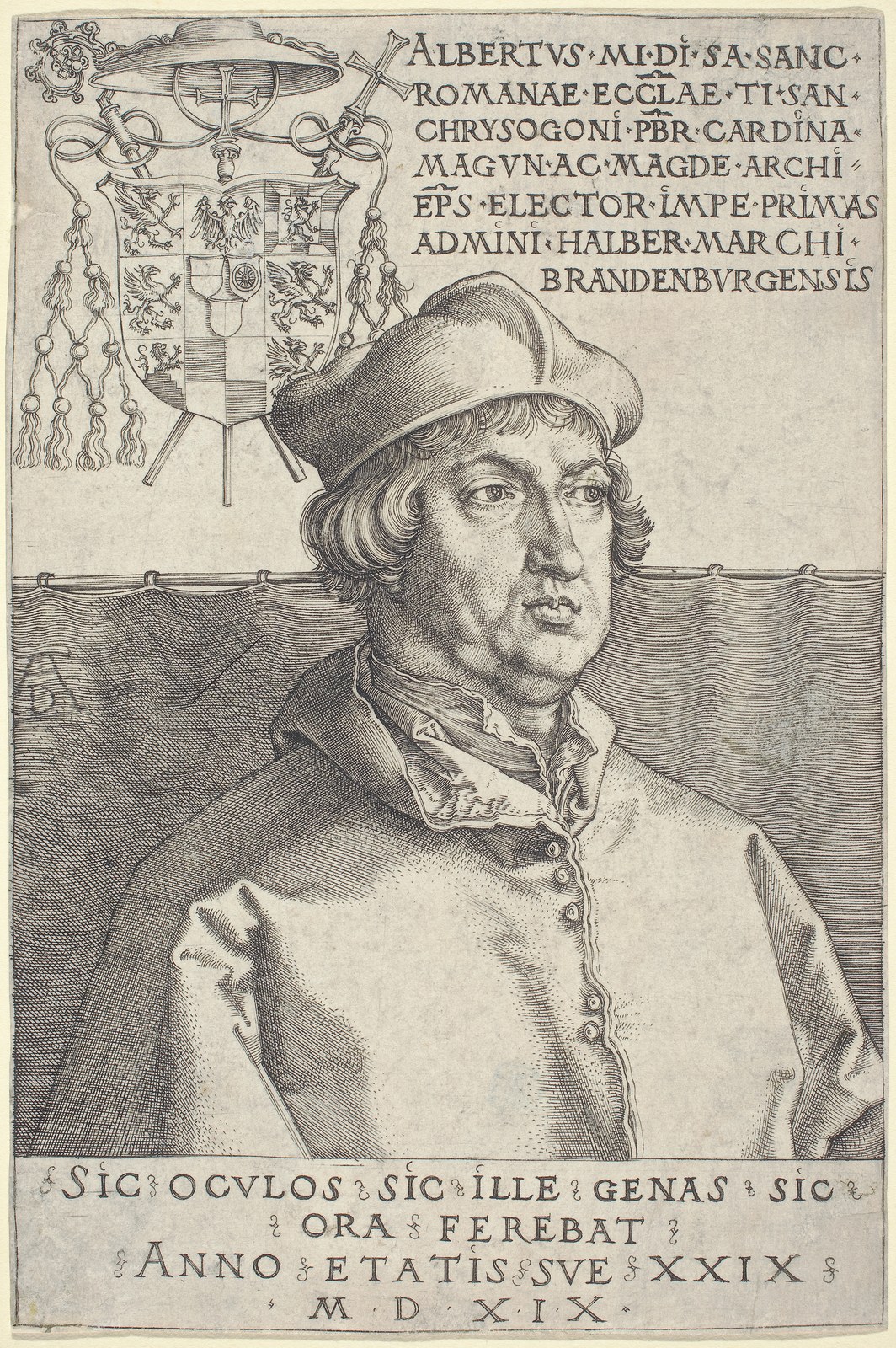
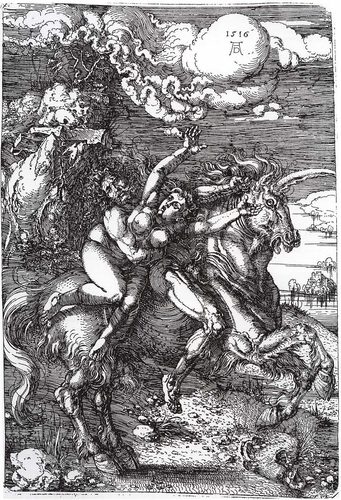
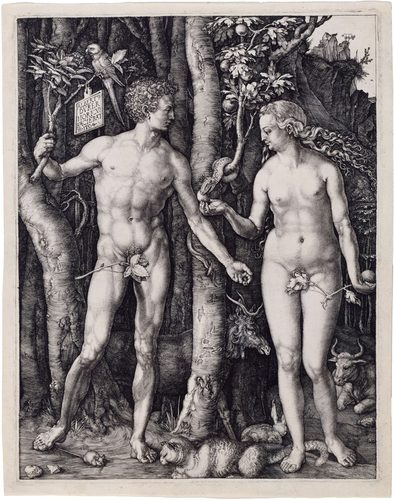
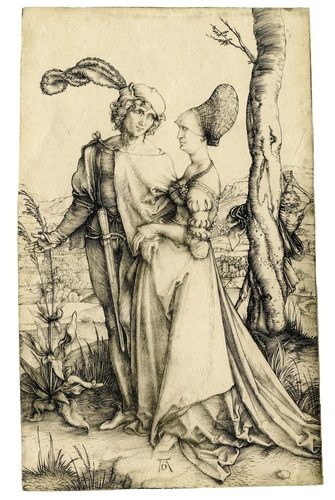
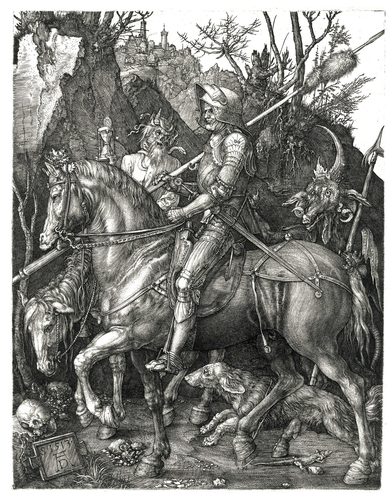
Nuremberg's art grew from its status as a Free Imperial City answerable directly to the Holy Roman Emperor rather than a local prince, governed instead by a patrician merchant council. Sitting at the crossing of major trade routes, it accumulated wealth through metalworking, goldsmithing, and, from 1470, one of Europe's largest printing presses under Anton Koberger. That press made Nuremberg a distribution hub for images as well as text, and Albrecht Dürer, trained locally under Michael Wolgemut and twice traveling to Venice, used copper engraving and woodcut to fuse Italian perspective and proportion theory with Northern Gothic detail. Alongside printmaking, Nuremberg workshops carved limewood altarpieces, sacrament houses, and figures for the city's two great parish churches, St. Sebald and St. Lorenz, often left unpainted to display the carver's raw skill. Patronage came from guilds, the council, and patrician families like the Tuchers and Pirckheimers rather than a court, keeping the city's art tied to civic and commercial life.
What marks the region
Engraving and woodcut mastery
Copper engraving and woodcut, refined by Dürer, let images travel far beyond the city through Nuremberg's presses, making prints as central to the school as any painted panel.
Unpainted limewood sculpture
Carvers such as Veit Stoss and Adam Kraft often left figures in bare limewood rather than gilding or painting them, foregrounding the carving itself as the display of mastery.
Guild-regulated workshops
Goldsmiths, brass casters, and metalworkers operated under strict guild rules, tying artistic training to the same civic structures that governed the city's trades.
Italian theory, Gothic detail
Dürer's Venetian trips brought back linear perspective and human proportion studies, which he grafted onto the dense ornament and angular drapery of Northern Gothic tradition.
Instrument and art overlap
The same workshop culture that produced altarpieces also built astrolabes, globes, and sundials, blending artistic craft with applied scientific instrument-making.
Civic, not courtly, patronage
With no resident prince, commissions came from the council, parish confraternities, and merchant families, keeping subject matter tied to civic and devotional life.
Local signatures
How to spot Nuremberg art
- AD monogram
- → Dürer's interlocking-letter signature, used to authenticate prints against the many contemporary copies circulating in his own lifetime.
- City skyline backdrop
- → Nuremberg's recognizable towers and walls inserted into woodcuts and altarpiece backgrounds, anchoring devotional scenes in local civic pride.
- Bare limewood grain
- → Unpainted wood left visible to showcase the carver's technical skill rather than concealing it under paint or gilding.
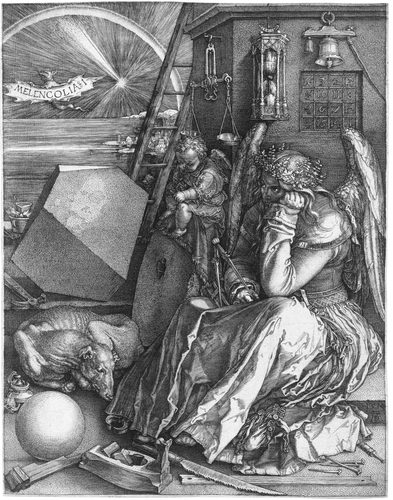
- Hourglass and skull
- → Memento mori motifs common in Nuremberg engravings, marking time's passage and mortality within otherwise learned or domestic scenes.
- Armillary sphere or compass
- → Symbols of measured knowledge tied to the city's parallel trade in scientific and navigational instruments.
- Patrician family crest
- → Donor coats of arms worked into altarpiece frames and stained glass, recording merchant family patronage of parish churches.
The story
Nuremberg held Free Imperial City status from the 13th century, governed by a patrician council rather than a prince. Trade routes across the Holy Roman Empire made it a metalworking and goldsmithing center, and in 1470 Johann Sensenschmidt brought the first printing press; Anton Koberger's later press became one of Europe's largest, producing the illustrated Nuremberg Chronicle in 1493. Albrecht Dürer, born 1471, trained under Michael Wolgemut, traveled to Venice in 1494-95 and 1505-07, and died in Nuremberg in 1528, leaving engravings that circulated across Europe. Veit Stoss carved the limewood Annunciation for St. Lorenz in 1517-18 and died in 1533; Adam Kraft completed St. Lorenz's stone sacrament house in 1496. The city adopted Lutheranism in 1525, curbing new altarpiece commissions, and the Thirty Years War (1618-48) alongside shifting trade routes ended Nuremberg's golden age by the mid-1600s.
Masterpieces of the place
| Work | Artist | Date | Why it matters |
|---|---|---|---|
| Melencolia I | Albrecht Dürer | 1514 | An engraving dense with instruments and symbols, showing Dürer's fusion of Italian theory and Northern craft precision. |
| The Four Apostles | Albrecht Dürer | 1526 | A late civic gift to Nuremberg's council, monumental in scale for a print-trained painter. |
| Nuremberg Chronicle woodcuts | Michael Wolgemut workshop | 1493 | Mass-produced illustrated history printed by Anton Koberger, showing the city's press at full scale. |
| Annunciation (Englischer Gruß) | Veit Stoss | 1517–1518 | Unpainted limewood relief suspended in St. Lorenz, a showcase of raw carving skill. |
| Self-Portrait at 28 | Albrecht Dürer | 1500 | A frontal, almost devotional self-image asserting the painter's status beyond craftsman. |
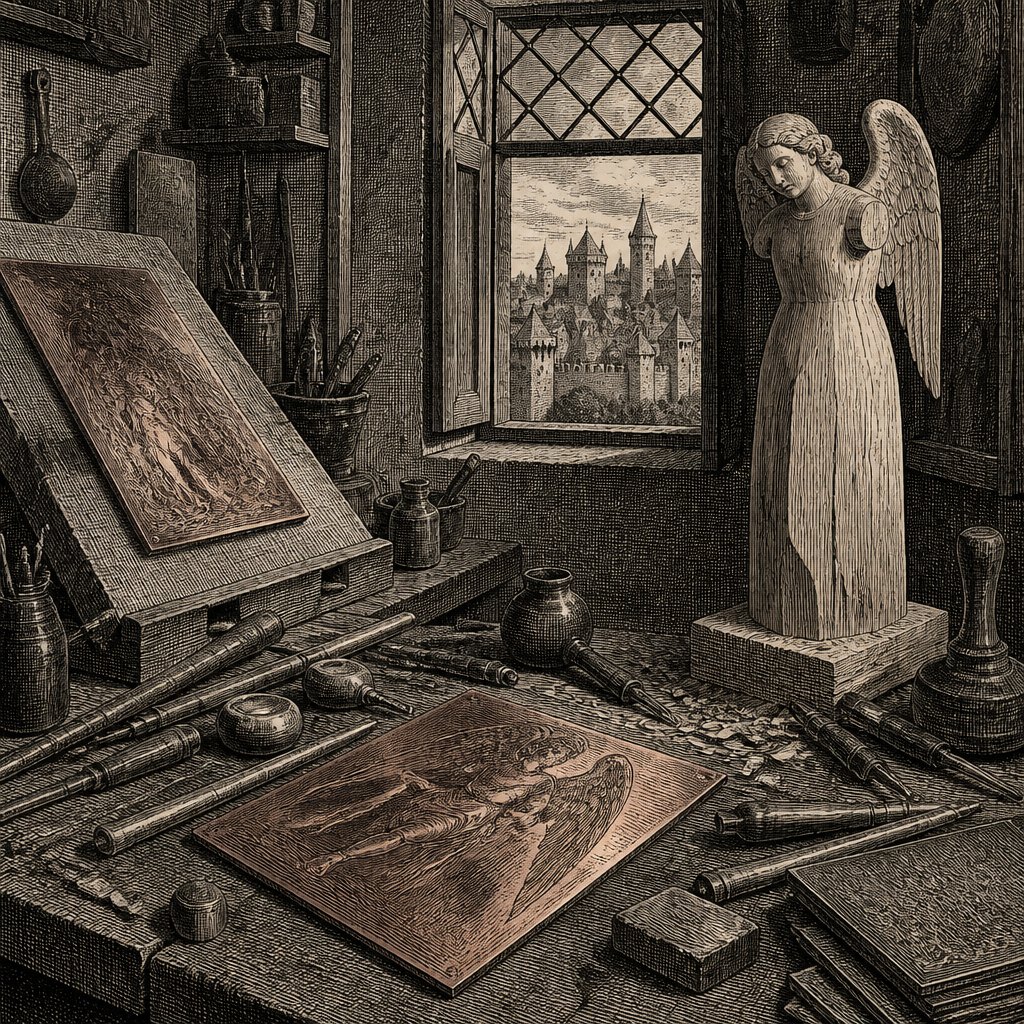 AI-generated
Work en plein air
Paint in the light of Nuremberg
This example was generated from a prompt like: “A cluttered engraver's workshop with copper plates, an unfinished bare limewood angel figure, dense cross-hatched shading tools on the bench, and a distant view of a turreted walled city glimpsed through a small leaded window.”
Open the Nuremberg Art Style generator →The place today
The Germanisches Nationalmuseum, founded 1852, holds a major Dürer collection alongside Nuremberg goldsmith and instrument work. The Albrecht-Dürer-Haus preserves the artist's former residence as a museum. St. Lorenz and St. Sebald still display Stoss and Kraft carvings in their original settings, letting visitors see limewood sculpture in the architecture it was made for. The city's long toy-making and metalworking trades, visible in its Toy Museum, extend the same guild-craft lineage into later centuries, though painting and printmaking on Dürer's scale no longer define the city's contemporary art scene.
Compose your own
Work in fine, controlled linework: dense cross-hatching for shadow, confined outlines for form, echoing engraving rather than loose brushwork. Apply Dürer's proportion studies by grounding figures in visible geometric measurement rather than free gesture. For sculpture, carve in limewood and leave the surface bare, letting tool marks and grain show through rather than smoothing everything under paint. Frame devotional or civic scenes with a recognizable turreted skyline or a small scientific instrument in the background, tying the image to Nuremberg's trade in both craft and knowledge. Keep ornament dense and angular, a Gothic habit that persisted even after Italian perspective arrived.
Frequently asked questions
What made Nuremberg different from other German art centers?
It was a self-governing Free Imperial City with no resident prince, funding art through guilds, the council, and merchant families, and its printing press gave it unusual reach for distributing images across Europe.
Why is Nuremberg tied so closely to printmaking?
Anton Koberger's press was among Europe's largest by the 1490s, and Albrecht Dürer refined copper engraving there into a medium precise enough to rival painting, circulating widely as portable prints.
Is Nuremberg sculpture typically painted?
Often not. Carvers such as Veit Stoss frequently left limewood bare to display the carving itself, a local variation on the usual Gothic practice of painting and gilding wood figures.
Why did Nuremberg's golden age end?
The city's 1525 adoption of Lutheranism reduced new altarpiece commissions, and the Thirty Years War along with shifting European trade routes eroded its economic base by the mid-1600s.