 Art
Art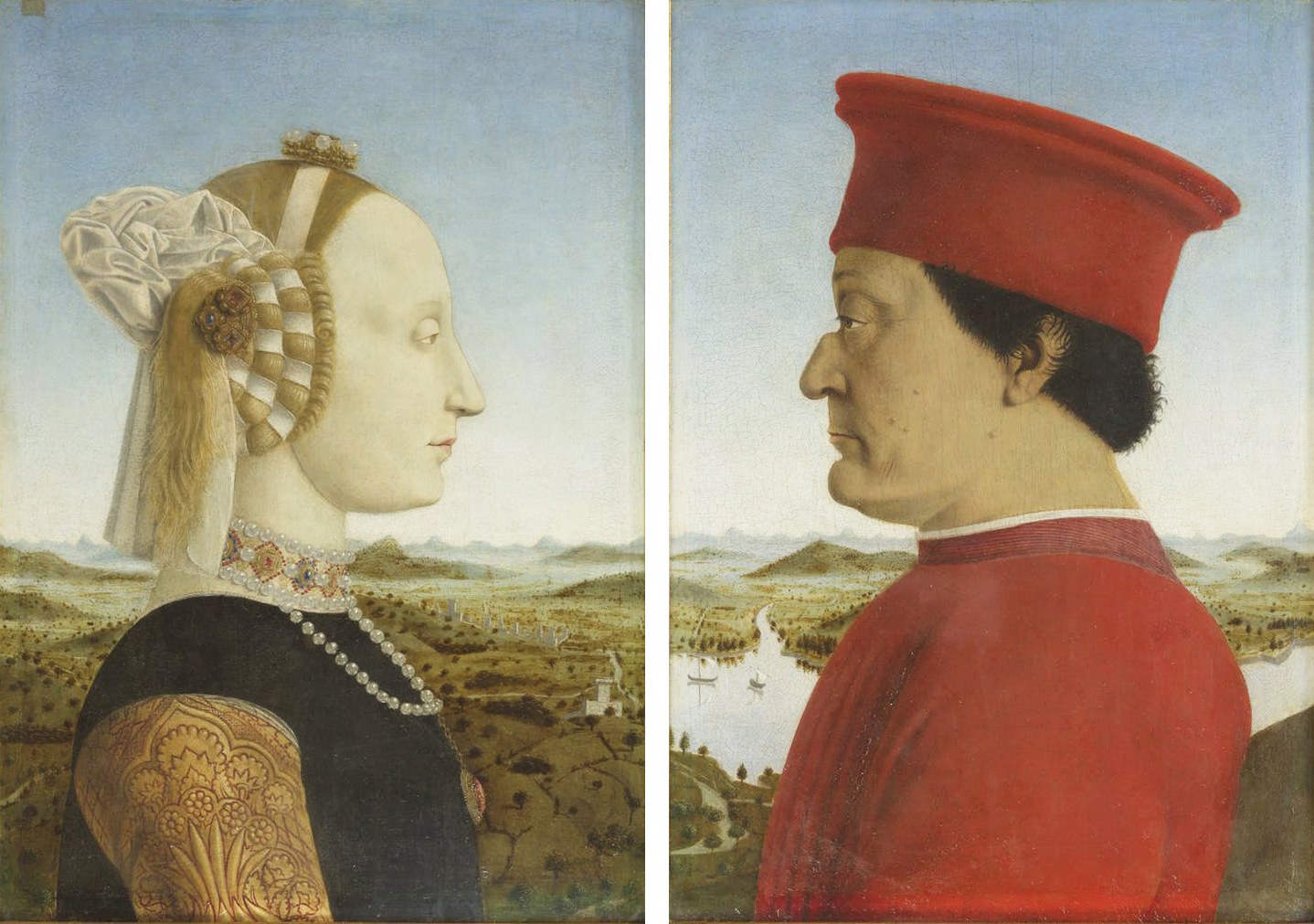
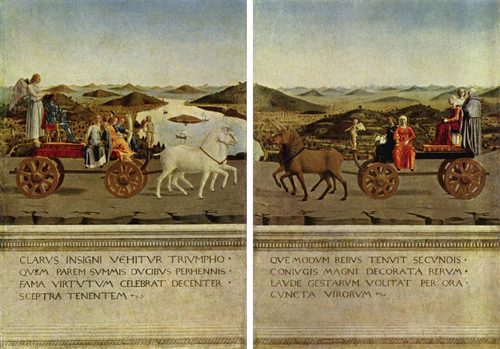
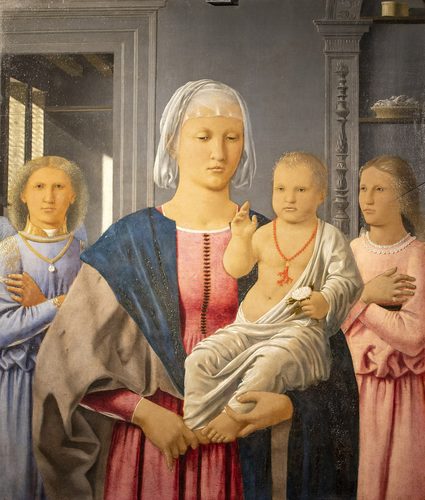
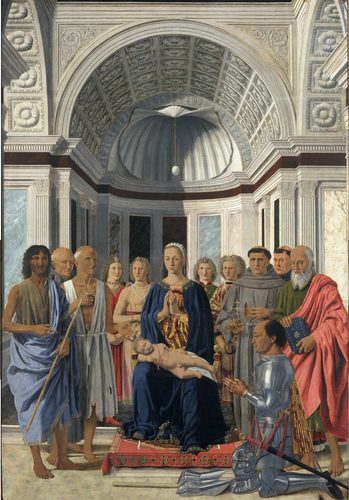
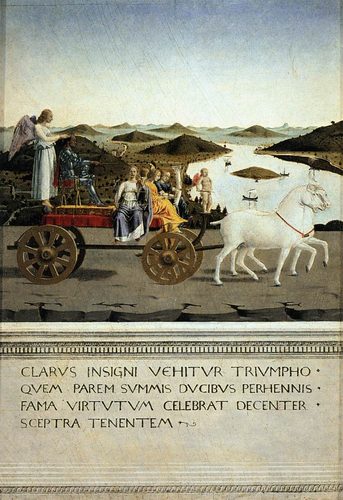
Urbino is the small hill-town in the Marche that became a major Renaissance art center almost entirely through the taste of one ruler, Federico da Montefeltro, condottiero and duke from 1444 to 1482. Lacking the wealth of Florence or Venice, Urbino compensated with concentrated patronage: Federico built the Palazzo Ducale into a showcase of mathematics, humanist learning, and painting, hiring Piero della Francesca, whose writings on perspective and solid geometry shaped a court style built on clear light and rigorous proportion rather than surface decoration. Federico's damaged right eye, lost in a jousting accident, fixed his image in strict profile, a convention that colored portraiture across the court. His studiolo, a small study lined with trompe l'oeil wood inlay, distilled the same values into furniture. Urbino also raised Raphael, son of court painter Giovanni Santi, before he left for wider fame, and later gave its name to a school of brilliantly painted maiolica pottery.
What marks the region
Linear perspective as doctrine
Piero della Francesca's mathematical treatises on perspective and solid geometry, written while at Urbino, made rigorous spatial construction the court's defining habit, more system than style.
Profile portraiture
Federico da Montefeltro lost the sight of his right eye and the bridge of his nose to jousting injuries, so court portraits show him strictly in left profile, a format later imitated across the palace.
Trompe l'oeil intarsia
Wood-inlay panels in the ducal studiolo simulate cabinets, instruments, and books in perfect illusionistic depth, applying painted perspective rules to furniture rather than canvas.
Imported technique
Duke Federico brought in the Flemish painter Justus of Ghent to introduce oil glazing to a court trained in tempera, blending Netherlandish material realism with Italian geometric structure.
Small-scale, high-precision panels
Court commissions favored intimate panel painting over large public fresco cycles, matching the private, scholarly character of a court built around a library and study rather than a cathedral.
Maiolica as painted narrative
Sixteenth-century Urbino workshops adapted istoriato ware, covering ceramic surfaces with full mythological and historical scenes borrowed directly from print sources and panel compositions.
Local signatures
How to spot Urbino art
- Strict left profile
- → Federico da Montefeltro's disfigured right side, hidden by turning every portrait to his undamaged left profile.
- Inlaid wood (intarsia) cabinets
- → Trompe l'oeil furniture panels signaling humanist learning and the studiolo tradition unique to Urbino.
- Receding checkerboard floors
- → Perspective grids demonstrating mastery of geometric space, a court obsession traceable to Piero della Francesca.
- Cool, even daylight
- → Clear, shadowless illumination distinguishing Urbino panels from the warmer glow of Florentine or Venetian painting.
- Istoriato maiolica scenes
- → Ceramic plates painted edge-to-edge with mythological narrative, Urbino's signature export ware of the 1500s.
- Architectural backdrops with classical orders
- → Idealized colonnades and piazzas reflecting the court's investment in humanist architectural theory.
The story
Federico da Montefeltro ruled Urbino as condottiero-duke from 1444 to 1482, using income earned as a mercenary commander to build one of the era's most sophisticated small courts. He rebuilt the Palazzo Ducale from the 1460s with architects Luciano Laurana and later Francesco di Giorgio Martini, and filled it with a library of humanist manuscripts and a studiolo decorated in trompe l'oeil wood inlay. Piero della Francesca worked for the court from around 1465, painting the Flagellation of Christ and the diptych portraits of Federico and his wife Battista Sforza while developing his treatise on perspective. The Flemish painter Justus of Ghent arrived around 1473-74 to paint the studiolo's Famous Men series, introducing oil technique. Federico's son Guidobaldo died without an heir in 1508, passing the duchy to the della Rovere family, under whom Urbino's maiolica workshops peaked in the 1520s-1540s. The duchy was absorbed into the Papal States in 1631.
Masterpieces of the place
| Work | Artist | Date | Why it matters |
|---|---|---|---|
| The Flagellation of Christ | Piero della Francesca | c. 1455-1460 | A small panel of exact geometric perspective whose meaning remains debated, still cited as a masterclass in constructed space. |
| Diptych of Federico da Montefeltro and Battista Sforza | Piero della Francesca | c. 1473-1475 | Twin profile portraits fixing the duke's damaged right side out of view against a distant Urbino landscape. |
| Studiolo of Federico da Montefeltro | Unknown | c. 1476 | Wood-inlaid cabinets simulating books, instruments, and armor in illusionistic depth for the duke's private study. |
| Portrait of a Young Woman (La Muta) | Raphael | c. 1507 | An early portrait by the Urbino-born painter, now held in the city's ducal palace collection. |
| Istoriato dish with mythological scene | Unknown | c. 1540s | A painted maiolica plate covering its surface with narrative scenes, the city's signature ceramic export. |
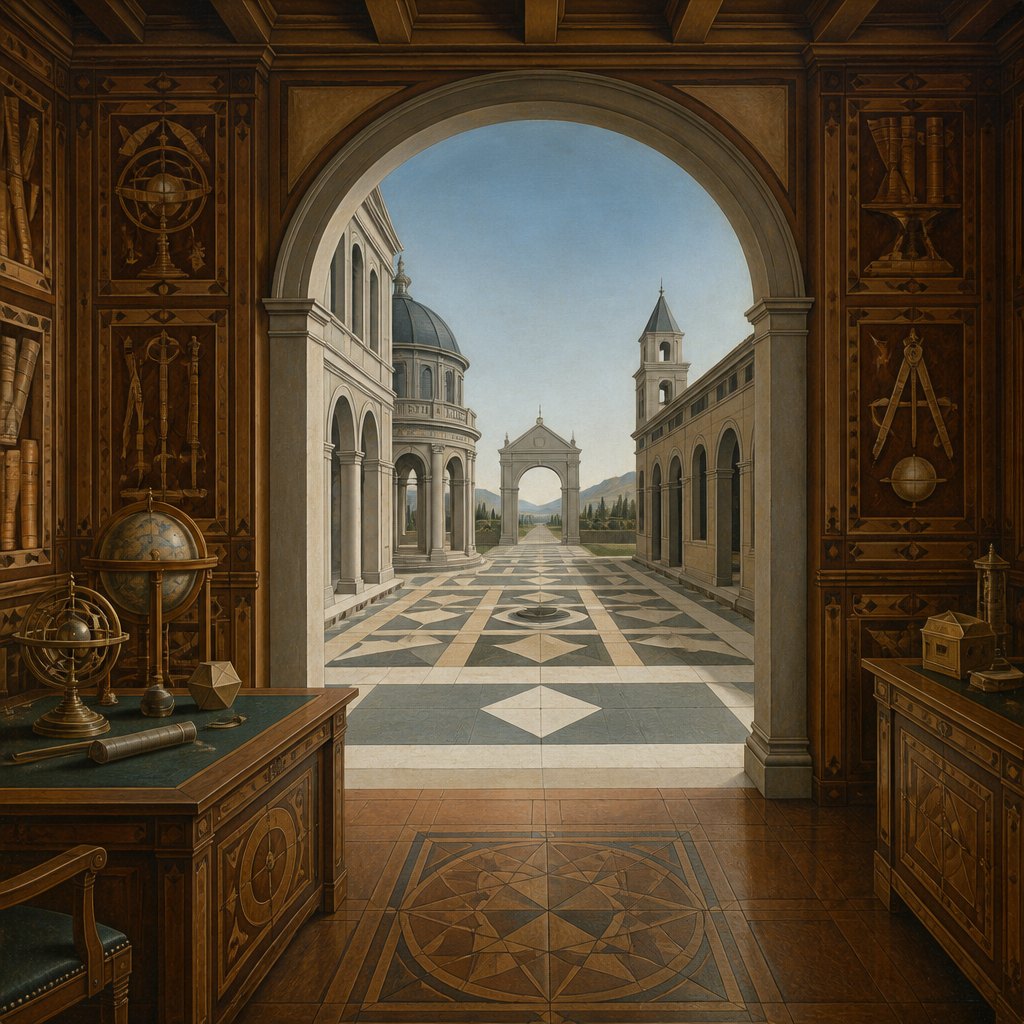 AI-generated
Work en plein air
Paint in the light of Urbino
This example was generated from a prompt like: “A duke's private study lined with wood-inlaid cabinets simulating books and instruments, seen beyond an archway opening onto a geometric perspective courtyard under cool, even daylight.”
Open the Urbino Art Style generator →The place today
The Palazzo Ducale now houses the Galleria Nazionale delle Marche, keeping Piero della Francesca's panels, Raphael's early portrait, and the intarsia studiolo in the rooms built to hold them. Urbino's compact historic center, largely unchanged since the 1400s, is itself a preserved example of the court's architectural ambitions. Ceramic workshops around the city still produce hand-painted maiolica using traditional istoriato techniques, sold to collectors and visitors rather than courts, keeping one strand of the old ducal economy alive.
Compose your own
Build the composition on a strict perspective grid before adding a single figure; floors, architraves, and receding colonnades should read as measured space, not backdrop. Light everything evenly and coolly, avoiding warm Florentine shadow, so forms sit in clear, almost shadowless daylight. If painting a portrait, consider a strict profile rather than a three-quarter turn, and keep the setting sparse: a plain sky, a distant hill town, a single ledge. For an object study, borrow the studiolo's trick of trompe l'oeil, rendering a cabinet, book, or instrument so precisely it argues with the flat surface it sits on. Keep the palette restrained, pale stone, cool blue distance, and a few clear local colors, letting geometry rather than color carry the composition's authority.
Frequently asked questions
Why did tiny Urbino become a major Renaissance art center?
One ruler, Federico da Montefeltro, concentrated exceptional wealth and taste into a single court, hiring Piero della Francesca and Justus of Ghent and building a palace and studiolo meant to rival any capital.
Why is Federico da Montefeltro always shown in profile?
A jousting injury cost him the sight of his right eye and part of his nose bridge, so court painters, notably Piero della Francesca, always depicted him from his undamaged left side.
Was Raphael trained in Urbino?
He was born there in 1483, the son of court painter Giovanni Santi, but his father died in 1494 and Raphael's main training happened afterward, in Perugia under Pietro Perugino.
What is Urbino maiolica?
A style of tin-glazed pottery developed in Urbino workshops in the 1500s, called istoriato ware for covering plates and dishes with full painted narrative scenes rather than simple ornament.