 Art
Art
Provincetown became one of the largest art colonies in the United States after 1899, when painter Charles Hawthorne founded the Cape Cod School of Art to teach plein air painting of fishermen, wharves, and dunes in broad, direct brushwork suited to the town's unusually clear maritime light. No wealthy patron underwrote the colony; students paid modest tuition, and cheap dune shacks and converted fish-houses made a summer season affordable for a growing American middle class of art students. Around 1915-16, a circle of painters working alongside B.J.O. Nordfeldt, several trained in Paris, developed the white-line woodcut: a single carved block divided into compartments, hand-inked in separate colors, and printed without a press using a wooden spoon or the back of a hand. This gave Provincetown a genuinely local invention distinct from any European printmaking tradition. From the 1930s, teaching that leaned toward European modernism pulled part of the colony toward abstraction, without displacing its working-waterfront core.
What marks the region
Plein air harbor painting
Broad, visible brushwork applied directly outdoors to capture fishing wharves, dories, and dune light, prioritizing immediate optical effect over studio finish.
White-line woodcut
A single block carved into compartmentalized shapes, inked section by section in separate colors, and printed by hand pressure rather than a mechanical press, producing slight variation between impressions.
Seasonal teaching colony
Summer art schools charging tuition, not court or church patronage, funded the colony, drawing large numbers of paying students rather than a small circle of commissioned painters.
High-key coastal palette
Clear Atlantic light was rendered as bright, high-contrast color relationships rather than the softer tonal shadow typical of inland American landscape painting.
Working waterfront subject
Fishing dories, nets, wharf pilings, and dune grass were treated as serious subject matter, not backdrop, reflecting the town's actual Portuguese and Yankee fishing economy.
Modernist overlay after 1930
Later teaching introduced Cubist-derived composition and abstraction, layered onto the colony's plein air habits rather than replacing them outright.
Local signatures
How to spot Provincetown art
- Weathered shingled fish shacks
- → Working waterfront architecture repurposed as cheap studios, a recurring subject and literal colony housing.
- Dune grass and sand dunes
- → The outer Cape's shifting dune landscape, painted and printed as the region's most distinctive terrain.
- Dories and fishing nets
- → Small open fishing boats and gear marking the town's working economy rather than a resort setting.
- Wharf pilings against light
- → Strong verticals used to structure harbor compositions against flat water and bright sky.
- Visible block divisions in prints
- → The carved compartment lines of a white-line woodcut, left visible as thin white borders between color areas.
- Gulls and mooring buoys
- → Small harbor shorthand marking scenes as specifically maritime rather than generic coastal landscape.
The story
Charles Hawthorne founded the Cape Cod School of Art in Provincetown in 1899, teaching plein air technique to summer students who soon numbered in the hundreds annually, making the town one of the largest art colonies in the country by the 1910s. The Provincetown Players theater group formed alongside the painters in 1915. That same period, printmaker B.J.O. Nordfeldt developed the white-line woodcut method, quickly adopted and refined by painters including Blanche Lazzell, who had trained in Paris; the group exhibited together as the Provincetown Printers from 1916. In 1914 the Provincetown Art Association was founded to collect and show the colony's work. Painter Hans Hofmann opened a summer school there in 1935, introducing a modernist, abstraction-leaning curriculum that coexisted with the older realist teaching through the following decades.
Masterpieces of the place
| Work | Artist | Date | Why it matters |
|---|---|---|---|
| Crew of the Philomena Manta | Charles W. Hawthorne | 1915 | A group portrait of Provincetown fishermen typical of Hawthorne's realist teaching subject matter. |
| Provincetown Harbor | E. Ambrose Webster | c. 1910 | A high-key color harbor scene by one of the colony's earliest resident painter-teachers. |
| White-Line Woodcut Landscape | Unknown | c. 1916 | An early example of the single-block color technique invented within the Provincetown Printers circle. |
| Cubist Still Life | Oliver N. Chaffee | c. 1917 | A modernist experiment reflecting the colony's early exposure to European avant-garde composition. |
| Ex Voto | Max Bohm | c. 1914 | A decorative, mural-scale allegorical work by a Beaux-Arts trained founder of the colony's Beachcombers club. |
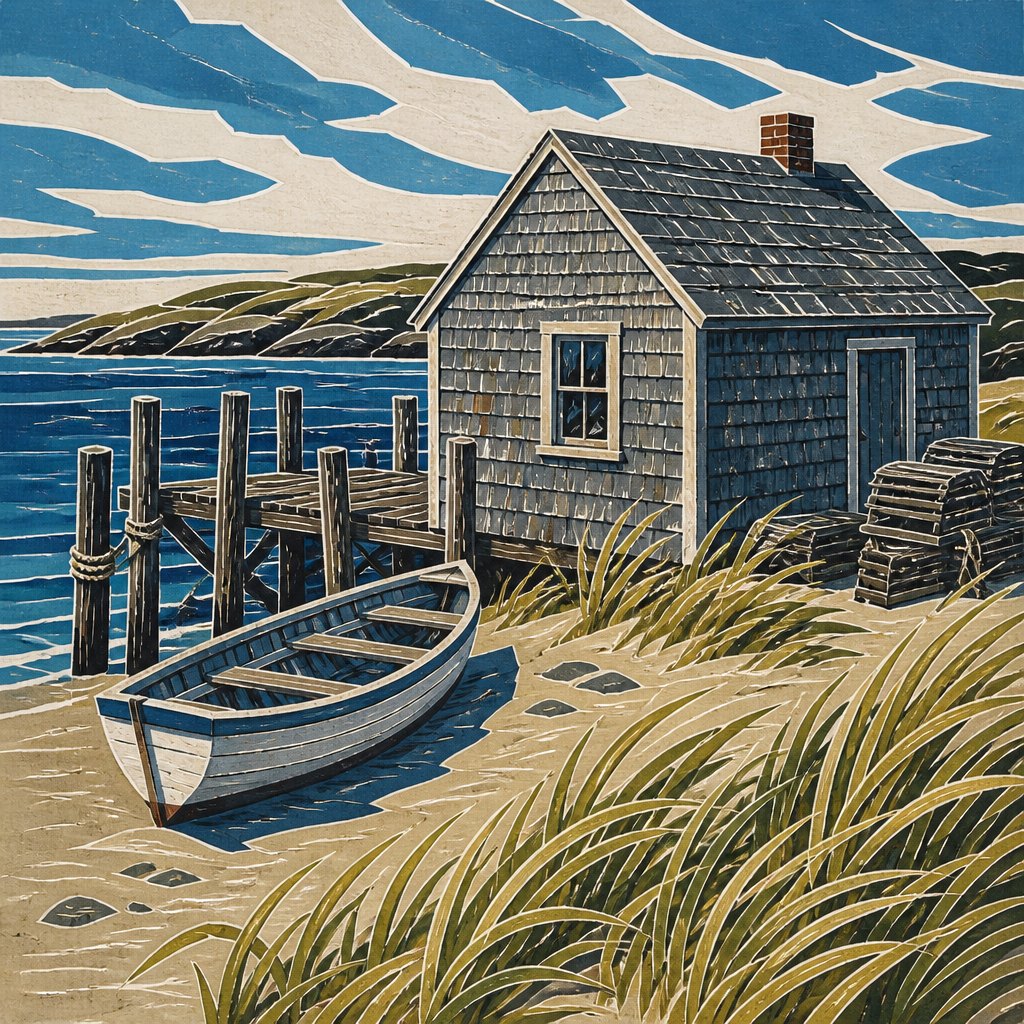 AI-generated
Work en plein air
Paint in the light of Provincetown
This example was generated from a prompt like: “A weathered shingled fish shack beside wooden wharf pilings, a small dory pulled onto sand, dune grass bending in bright coastal light, rendered in bold flat colors with thin white divisions between shapes, evoking a hand-printed woodcut.”
Open the Provincetown Art Style generator →The place today
The Provincetown Art Association and Museum, founded in 1914, holds the core colony collection and continues public exhibitions. Cape Cod National Seashore, established 1961, preserves the dune landscape that defined the colony's palette. White-line woodcut printmaking is still taught in local workshops as a hands-on craft, and Commercial Street galleries continue a continuous exhibition tradition dating to the colony's founding decades.
Compose your own
For painting, work outdoors with a loaded brush and visible, confident strokes rather than blended tone, letting bright Atlantic light read as sharp color contrast between sunlit and shadowed planes. Center subjects on the working waterfront: dories, nets, wharf pilings, weathered shingle, not resort imagery. For prints, carve a single block into distinct compartments, ink each section by hand in a separate flat color, and print with hand pressure rather than a mechanical press so a thin unprinted white line remains visible between color areas. Keep the palette high-key and slightly flattened, avoiding the deep tonal shadow of academic studio painting in favor of open-air immediacy.
Frequently asked questions
What is a white-line woodcut and where did it originate?
It is a single wood block carved into compartments, inked separately in flat colors, and printed by hand rather than a press. The technique was developed in Provincetown around 1915-16 and remains a locally invented printmaking method.
Why did Provincetown become such a large art colony?
Charles Hawthorne's Cape Cod School of Art, founded in 1899, drew large paying summer student numbers, and cheap fish-house studios and dune shacks made an extended stay affordable, unlike patron-funded colonies elsewhere.
Did Provincetown art stay purely realist?
No. Alongside the founding realist, plein air tradition, printmakers pushed toward abstraction from the mid-1910s, and Hans Hofmann's 1935 summer school introduced modernist composition that coexisted with older teaching.
Is the white-line woodcut still practiced today?
Yes, as a living craft taught in local Provincetown printmaking workshops and studios, continuing the hand-inking, hand-printing method developed by the original Provincetown Printers circle.